Choosing the right educational support for a child can be challenging, especially when the child is studying under the British curriculum in Nigeria.
Unlike the Nigerian national curriculum, the British curriculum follows a structured international pathway that can include Cambridge Primary, Cambridge Lower Secondary, Cambridge IGCSE, International GCSE, AS & A-Level and other internationally recognised qualifications.
For parents, understanding these stages is important. More importantly, finding a tutor who understands the curriculum, the examination board and the expectations of the learner's school can make a significant difference.
This guide explains the British curriculum pathway, the major stages students may encounter, how Cambridge Checkpoint and IGCSE fit into the system, and what parents should look for when choosing a British curriculum tutor in Nigeria.
What Is the British Curriculum?
The British curriculum is an internationally recognised educational framework used by schools in the United Kingdom and by many international schools around the world.
In Nigeria, several international and private schools use British or British-influenced curricula. Students may follow Cambridge programmes, Pearson Edexcel qualifications, or other British examination pathways depending on their school.
The curriculum places considerable emphasis on subject knowledge, understanding, problem-solving, critical thinking, communication and independent learning.
For example, Cambridge IGCSE is designed for learners typically aged 14–16 and offers a wide range of subjects. Cambridge states that the qualification has more than 70 subject options and is designed to develop knowledge, understanding and skills including creative thinking, enquiry and problem-solving.
This means that succeeding in a British curriculum school is not simply about memorising information.
Students need to understand concepts and know how to apply them.
Understanding the British Curriculum Pathway
One of the biggest challenges for parents is understanding how the different stages connect.
Although individual schools may structure their academic years differently, the Cambridge pathway broadly progresses from primary education through lower secondary, IGCSE and advanced-level study.
A simplified pathway looks like this:
Cambridge Primary → Cambridge Lower Secondary → Cambridge IGCSE → Cambridge International AS & A Level
The Cambridge curriculum guide places Cambridge Primary around ages 5–11, Cambridge Lower Secondary around ages 11–14, IGCSE around ages 14–16 and AS & A Level around ages 16–18.
However, parents should always check their child's specific school programme because year-group naming and examination timing can vary.
Cambridge Primary
Cambridge Primary generally supports learners during the early years of formal education.
Core areas can include:
- Mathematics
- English
- Science
- Global perspectives
- Computing and other subjects depending on the school's programme
At this stage, tutoring should focus less on examination pressure and more on developing strong foundations.
A child who develops strong numeracy, literacy, reasoning and problem-solving skills in primary school is likely to have a stronger foundation for lower secondary education.
For parents, this means a good tutor should not simply help a child complete homework.
The tutor should help the learner understand why an answer is correct.
Cambridge Primary Checkpoint
Cambridge Primary Checkpoint provides an external assessment of learners' progress toward the end of Cambridge Primary.
The programme covers important areas including Mathematics, English and Science and provides an international benchmark of learner performance.
Parents considering tutoring at this stage should look for support that combines:
- Concept development
- Problem-solving
- Reading comprehension
- Mathematical reasoning
- Scientific understanding
- Examination familiarity
- Regular assessment
The objective should be to build a strong academic foundation rather than simply teach students how to answer past questions.
Cambridge Lower Secondary
Cambridge Lower Secondary typically serves learners between approximately 11 and 14 years old.
This stage is particularly important because students begin moving toward the more demanding academic expectations associated with IGCSE.
Subjects commonly include:
- Mathematics
- English
- Science
- Computing
- Humanities
- Languages
- Global Perspectives
The exact subjects depend on the school.
Students at this stage increasingly need to develop independent learning skills.
They need to be able to analyse questions, explain their reasoning, interpret information and apply concepts to unfamiliar situations.
Cambridge Lower Secondary Checkpoint
Cambridge Lower Secondary Checkpoint is an important assessment for students approaching the end of lower secondary education.
The British Council explains that Cambridge Lower Secondary Checkpoint covers Mathematics, English and Science and is designed to assess students at approximately ages 11–13. It also provides preparation for higher Cambridge qualifications such as IGCSE.
This makes Checkpoint preparation an important area for parents to consider when looking for a British curriculum tutor in Nigeria.
A strong Checkpoint tutor should be able to identify:
- Topics the learner has mastered
- Topics requiring reinforcement
- Examination weaknesses
- Gaps in foundational knowledge
- Problems with examination technique
- Difficulties with time management
The tutor can then create a targeted learning programme rather than teaching every topic at the same pace.
What Is IGCSE?
The International General Certificate of Secondary Education, commonly called IGCSE, is one of the most widely recognised international secondary qualifications.
Cambridge describes IGCSE as an international qualification generally taken by students aged 14–16.
The qualification is designed to develop more than factual knowledge.
Students are expected to develop skills such as:
- Critical thinking
- Problem-solving
- Analysis
- Research
- Communication
- Application of knowledge
This is one reason why IGCSE tutoring requires a different approach from ordinary homework assistance.
Cambridge IGCSE vs GCSE
Parents sometimes use the terms IGCSE and GCSE interchangeably, but they are not exactly the same qualification.
GCSE is traditionally associated with the UK education system, while IGCSE is an international qualification designed for students around the world.
Cambridge explains that its IGCSE standards are aligned with the GCSE qualification taken in England.
For a Nigerian student attending an international school, the exact qualification depends on the programme and examination board used by the school.
Parents should therefore ask:
Which examination board does my child's school use?
The answer may be Cambridge, Pearson Edexcel or another recognised examination provider.
This question is extremely important when selecting a private tutor.
Why Examination Board Matters When Choosing a Tutor
A tutor may be excellent at Mathematics but still not be the right tutor for a particular IGCSE learner.
Why?
Because different examination boards can have different:
- Syllabuses
- Question structures
- Assessment objectives
- Mark schemes
- Practical requirements
- Examination techniques
A good tutor should therefore ask about the student's examination board before beginning intensive exam preparation.
For example, a parent looking for an IGCSE Mathematics tutor in Nigeria should ideally provide the tutor with the learner's:
- Examination board
- Syllabus code
- Current school level
- Recent assessment results
- Areas of difficulty
- Target grade
- Examination session
This allows the tutor to develop a much more precise learning plan.
British Curriculum Subjects That Often Require Private Tutoring
Students following the British curriculum may require additional support in a wide range of subjects.
Some of the most common include:
Mathematics
British curriculum Mathematics can progress from foundational arithmetic and algebra to increasingly complex topics such as:
- Algebra
- Functions
- Geometry
- Trigonometry
- Statistics
- Probability
- Vectors
- Calculus at advanced levels
A tutor should help students understand mathematical concepts rather than rely entirely on memorisation.
English Language
English tutoring can cover:
- Grammar
- Vocabulary
- Reading comprehension
- Summary writing
- Creative writing
- Analytical writing
- Argumentative writing
- Examination technique
English Literature
Students may require help with:
- Text analysis
- Characterisation
- Themes
- Structure
- Literary techniques
- Essay organisation
- Evidence and interpretation
Biology
British curriculum Biology requires students to understand biological concepts and apply them to unfamiliar situations.
Chemistry
Chemistry students may need support with:
- Atomic structure
- Bonding
- Stoichiometry
- Organic chemistry
- Rates of reaction
- Energetics
- Equilibrium
- Practical skills
Physics
Physics tutoring may cover:
- Mechanics
- Electricity
- Waves
- Energy
- Thermal physics
- Magnetism
- Nuclear physics
- Practical investigations
Computer Science
Computer Science is increasingly important for students preparing for university and technology-related careers.
Support may include:
- Programming
- Algorithms
- Computational thinking
- Data representation
- Computer systems
- Networks
- Cybersecurity
- Problem-solving
When Should a Child Start British Curriculum Tutoring?
There is no universal age at which every child needs private tutoring.
Some learners may need support because they are struggling with a particular topic.
Others may want additional academic challenges even when they are already performing well.
Parents may consider tutoring when a child:
- Has consistently declining grades
- Struggles with Mathematics or Science
- Finds English writing difficult
- Has difficulty completing assignments independently
- Is preparing for Checkpoint
- Is preparing for IGCSE
- Is preparing for GCSE
- Is moving between educational systems
- Needs help preparing for A-Level
- Wants to achieve a higher target grade
- Needs structured examination preparation
Early intervention can also prevent small learning gaps from becoming major problems later.
How to Choose a British Curriculum Tutor in Nigeria
Choosing a tutor should involve more than asking, "How much does the tutor charge?"
Parents should consider several factors.
1. Curriculum Experience
Ask whether the tutor has experience with the exact curriculum the child is studying.
Someone who teaches the Nigerian curriculum may be an excellent teacher but may not automatically understand Cambridge IGCSE or another international examination board.
2. Examination Board Experience
For examination students, ask whether the tutor understands the relevant board.
For example:
- Cambridge
- Pearson Edexcel
- OxfordAQA
The tutor should be comfortable working with the relevant syllabus and assessment style.
3. Subject Specialisation
A specialist Mathematics tutor may be preferable for a learner struggling with advanced Mathematics.
Similarly, a student preparing for IGCSE Chemistry may benefit from a tutor who regularly teaches Chemistry rather than a general academic tutor.
4. Personalised Learning
Children do not all learn at the same pace.
A strong tutoring programme should identify the student's weaknesses and create lessons around those needs.
5. Regular Assessment
Parents should be able to see whether the tutoring programme is producing progress.
Regular assessments can help identify improvement and remaining weaknesses.
6. Examination Practice
For students approaching major examinations, tutoring should eventually include structured practice with examination-style questions.
Students should learn:
- How to interpret questions
- How to structure answers
- How to manage time
- How to identify command words
- How marks are awarded
- How to avoid common mistakes
Online British Curriculum Tutoring in Nigeria
Online tutoring has made it possible for students across Nigeria to access specialist tutors without requiring the tutor to live nearby.
A student in Lagos can receive lessons from a tutor who is elsewhere in Nigeria, while a learner in Abuja, Port Harcourt or Ibadan can also receive personalised online support.
For international-school families, online tutoring can be particularly convenient.
Students can receive lessons from home using video conferencing and digital learning resources.
The important question is not simply whether tutoring is online.
The important question is whether the online lesson is interactive, structured and personalised.
British Curriculum Tutors in Lagos
Lagos has a large population of international schools and families seeking British and international educational pathways.
Parents looking for a British curriculum tutor in Lagos may be searching for support in areas such as:
- Lekki
- Victoria Island
- Ikoyi
- Ikeja
- Surulere
- Yaba
- Magodo
- Lagos Island
Online tutoring can eliminate the challenge of travelling across Lagos while still providing one-on-one instruction.
British Curriculum Tutors in Abuja
Families in Abuja also have access to online British curriculum tutoring.
Students in areas such as Maitama, Asokoro, Wuse, Gwarinpa and surrounding communities can receive personalised tutoring without depending entirely on physical proximity to a tutor.
This can be particularly useful for families with demanding schedules.
British Curriculum Tutoring for Nigerian Students Living Abroad
British curriculum tutoring is not limited to students physically attending schools in Nigeria.
Nigerian families living in the UK, Canada and other countries may also seek tutors who understand international examination systems while providing lessons from Nigeria.
This can provide flexibility for families looking for online one-to-one academic support.
However, parents should always confirm that the tutor understands the student's actual school curriculum and examination board, rather than assuming that every British or international curriculum is identical.
How Glareminds Supports British Curriculum Students
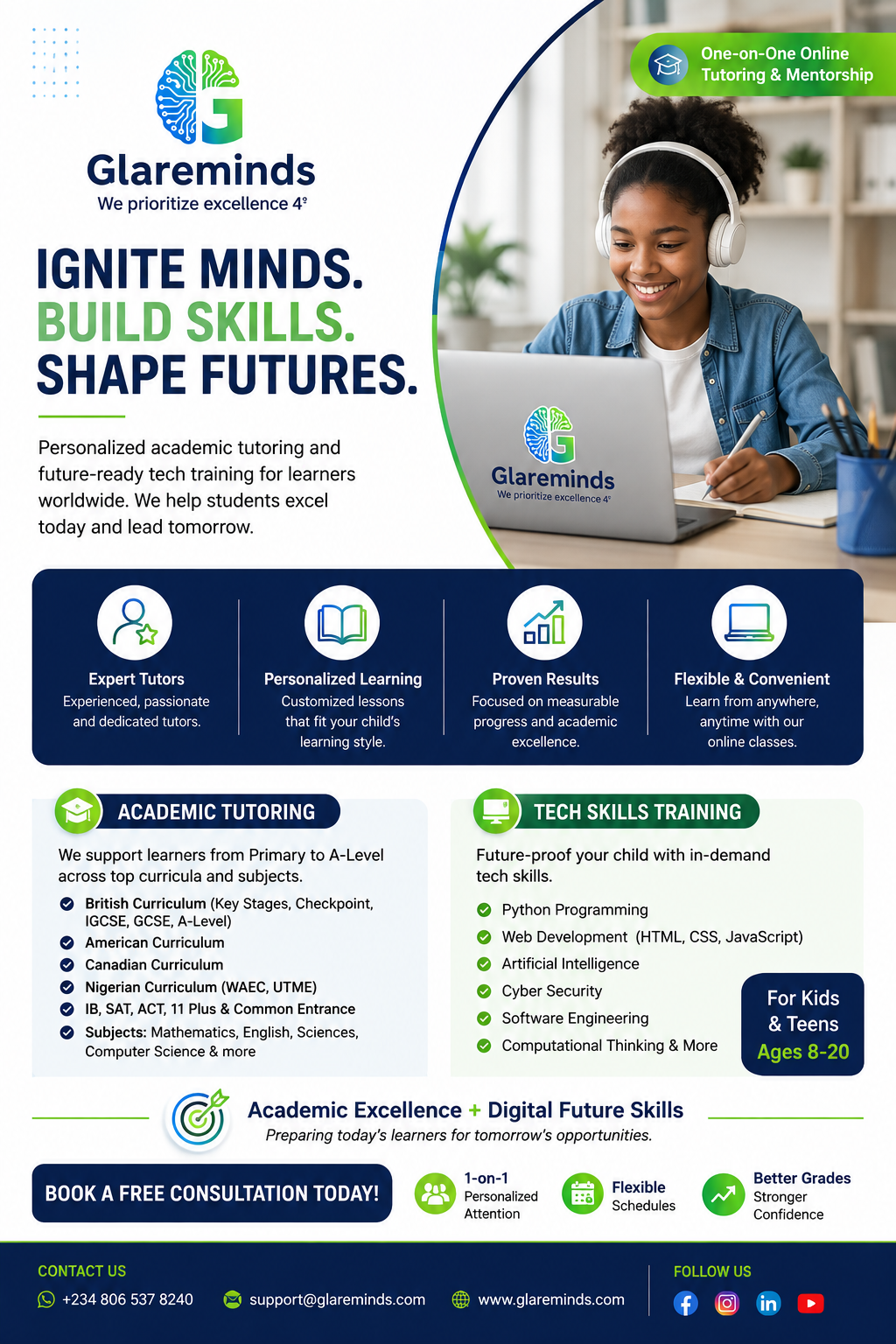
Glareminds provides personalised online tutoring for students studying British and international curricula.
Its programmes include British curriculum tutoring, Cambridge Checkpoint preparation, IGCSE tutoring, GCSE support and academic mentorship.
The focus is on one-to-one learning, allowing lessons to be adapted to the learner's academic level, weaknesses and objectives.
Glareminds also supports students in subjects including Mathematics, English, Biology, Chemistry, Physics, Computer Science and other academic areas.
One distinguishing aspect of the Glareminds approach is the combination of academic tutoring with technology education.
Students who want to develop future-ready skills can also explore areas such as programming, web development, artificial intelligence and computational thinking.
This creates an educational model that aims to support both academic performance and long-term digital skills development.
Why Personalised Tutoring Can Make a Difference
A classroom teacher may have to support many students simultaneously.
A private tutor can focus on one learner.
That allows the lesson to move according to the student's needs.
For example, imagine a Year 9 student who understands most Mathematics topics but struggles with algebraic manipulation.
Instead of spending an entire lesson revising topics the student already understands, a personalised tutor can identify the specific algebraic concepts causing difficulty and dedicate more time to them.
The same principle applies to IGCSE preparation.
A student who performs strongly in algebra but struggles with geometry should not necessarily spend equal amounts of revision time on both.
Effective tutoring should be targeted.
British Curriculum Tutoring Should Go Beyond Homework
One of the common misconceptions about private tutoring is that it is simply homework assistance.
High-quality tutoring should go further.
A good tutor should help students develop:
- Independent learning
- Critical thinking
- Problem-solving
- Communication
- Examination technique
- Time management
- Confidence
- Study discipline
These skills can become increasingly important as students progress toward IGCSE and A-Level.
Preparing for IGCSE: When Should Revision Begin?
IGCSE preparation should not necessarily begin only a few weeks before the examination.
The strongest preparation is usually built gradually.
Early Stage
Focus on understanding the syllabus and identifying gaps.
Development Stage
Strengthen difficult concepts and practise applying knowledge.
Examination Stage
Introduce structured examination practice, timed papers and detailed review of mistakes.
Final Revision Stage
Focus on weak areas, examination technique, time management and confidence.
Parents should therefore think of IGCSE preparation as a process rather than a last-minute event.
Cambridge Checkpoint and IGCSE: How They Connect
Cambridge Lower Secondary Checkpoint can serve as an important transition toward IGCSE.
The British Council describes Checkpoint as a programme that develops Mathematics, English and Science knowledge and skills and prepares students for IGCSE and International GCSE pathways.
This means parents should not necessarily view Checkpoint as an isolated examination.
It can be part of the learner's broader academic progression.
Strong foundations at lower secondary level can make the transition into IGCSE more manageable.
What About A-Level?
After IGCSE or equivalent qualifications, many students progress to advanced-level study.
Cambridge International AS & A Level generally serves learners around ages 16–18.
A-Level subjects require deeper subject knowledge and increasingly sophisticated analysis.
Students may study subjects such as:
- Mathematics
- Further Mathematics
- Physics
- Chemistry
- Biology
- Economics
- Business
- Computer Science
- English
- Geography
- History
The exact subject combination depends on the learner's school and future plans.
Students considering competitive university programmes should plan their A-Level subjects carefully and seek appropriate academic guidance.
Questions Parents Should Ask Before Hiring a Tutor
Before choosing a British curriculum tutor, ask:
1. Which British curriculum programmes do you teach?
2. Do you teach Cambridge or Pearson Edexcel?
3. Have you taught the specific year group my child is in?
4. Do you understand the examination board and syllabus?
5. How do you assess a student's weaknesses?
6. Will my child receive a personalised learning plan?
7. How frequently will progress be reported?
8. Do you use examination-style questions?
9. Can lessons be adapted if my child's school moves faster or slower than expected?
10. Can the tutoring programme support both academic improvement and examination preparation?
These questions can help parents distinguish between general tutoring and genuine curriculum-specific support.
Frequently Asked Questions About British Curriculum Tutoring in Nigeria
What is the British curriculum?
The British curriculum refers to educational programmes and qualifications based on British educational frameworks and examination systems. In Nigeria, international schools may use Cambridge, Pearson Edexcel or other British/international pathways.
What age do students take IGCSE?
Cambridge IGCSE is generally designed for students aged 14–16.
What is Cambridge Checkpoint?
Cambridge Checkpoint is an assessment programme used at Cambridge Primary and Cambridge Lower Secondary stages to provide an external benchmark of student progress. Lower Secondary Checkpoint focuses on areas including Mathematics, English and Science and can prepare students for IGCSE.
Is IGCSE the same as GCSE?
No. They are different qualifications, although Cambridge states that its IGCSE standards are aligned with the GCSE qualification taken in England.
Can students in Nigeria take IGCSE examinations?
Yes. The British Council provides examination registration services for Cambridge examinations in Nigeria, including IGCSE and Checkpoint for eligible candidates.
Can my child have a British curriculum tutor online?
Yes. Online one-to-one tutoring allows students in Lagos, Abuja, Port Harcourt, Ibadan and other locations to access tutoring without requiring physical lessons.
Does Glareminds offer British curriculum tutoring?
Yes. Glareminds offers online tutoring and academic support for British and international curricula, including Cambridge Checkpoint, IGCSE and GCSE preparation.
Final Thoughts for Parents
The British curriculum offers students a structured pathway from foundational education through lower secondary, IGCSE and advanced-level study.
However, following an international curriculum does not automatically guarantee academic success.
Students still need strong foundations, effective study habits, subject knowledge and the ability to apply what they have learned.
For some learners, personalised tutoring can provide the additional support required to overcome difficult topics, prepare for examinations and build academic confidence.
The most important consideration when choosing a tutor is not simply the tutor's location or price.
Parents should look for someone who understands the learner's curriculum, year group, examination board, subject requirements and individual learning needs.
For families looking for personalised British curriculum tutoring in Nigeria and internationally, Glareminds provides one-to-one academic tutoring, Cambridge Checkpoint preparation, IGCSE support, GCSE tutoring and academic mentorship.
Explore Glareminds British Curriculum & IGCSE Tutoring
Give your child the right academic foundation today — and help them build the skills they need for tomorrow.