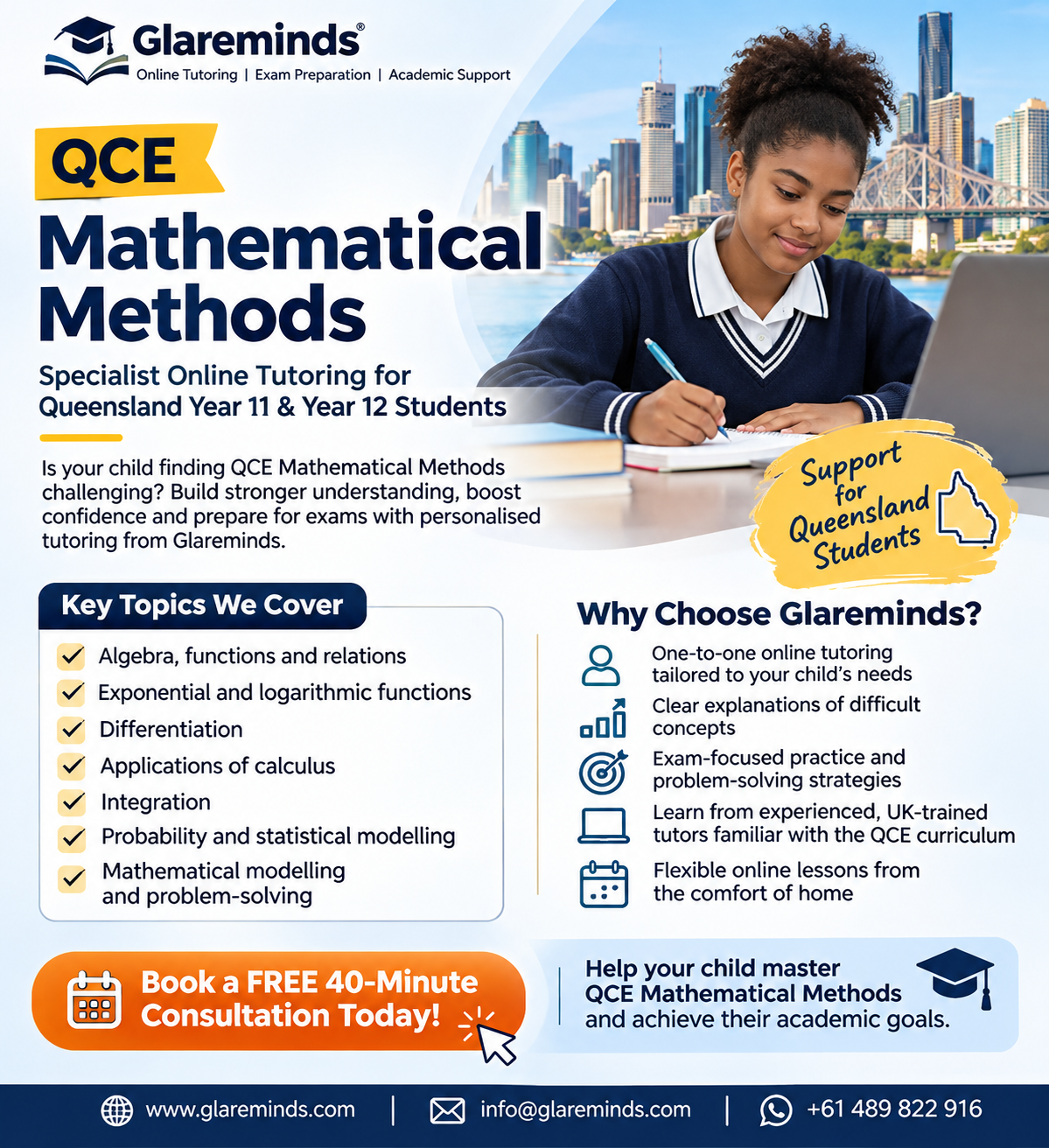
Is your child finding QCE Mathematical Methods increasingly difficult? Are they struggling with functions, calculus, algebra or examination questions despite spending hours studying?
For many students in Queensland, Mathematical Methods is one of the most demanding senior secondary subjects. It requires more than memorising formulas or following worked examples. Students must understand mathematical relationships, interpret graphs, apply calculus techniques and solve unfamiliar problems with accuracy.
The transition from Year 10 Mathematics to Year 11 Mathematical Methods can be particularly challenging. Concepts become more abstract, questions require deeper reasoning, and students are expected to apply several mathematical skills within a single problem.
For parents, watching a previously confident mathematics student begin to struggle can be concerning. A student who performs well in basic algebra may suddenly find functions difficult. Another may understand differentiation during lessons but struggle to apply it in examination questions.
These difficulties are not unusual. However, identifying them early and providing the right academic support can make a significant difference.
At Glareminds, we provide personalised online mathematics tutoring designed to help students strengthen their understanding, address learning gaps and develop confidence in challenging subjects.
In this guide, we explore QCE Mathematical Methods, the topics Queensland students need to understand, common academic difficulties, examination preparation strategies and how specialist tutoring can help.
What Is QCE Mathematical Methods?
QCE Mathematical Methods is a senior secondary mathematics subject within the Queensland Certificate of Education (QCE) system.
It is designed for students who want to develop advanced mathematical knowledge and problem-solving skills.
The subject builds on foundational mathematics and introduces more advanced concepts involving algebra, functions, calculus, probability and statistical reasoning.
Mathematical Methods is particularly relevant to students considering further study in areas such as:
- Engineering.
- Mathematics.
- Physics.
- Computer science.
- Data science.
- Economics.
- Certain health and science-related university programmes.
It also develops analytical skills that are useful beyond the classroom.
Students who choose Mathematical Methods should be comfortable working with algebraic expressions, graphs, equations and multi-step mathematical problems.
Why Do Students Find QCE Mathematical Methods Difficult?
Many students enter Year 11 with reasonable mathematical foundations but discover that Mathematical Methods demands a different level of understanding.
Here are some common reasons students struggle.
1. The jump from Year 10 Mathematics to Mathematical Methods
The transition into senior secondary mathematics introduces more abstract concepts and complex applications.
Students who previously relied on memorising procedures may find it difficult to understand why particular mathematical methods work.
For example, a student may know how to solve a simple linear equation but struggle when required to analyse a function, interpret its graph and explain how its properties relate to a real-world situation.
The challenge is not always the complexity of the calculation. It is understanding the relationship between different mathematical ideas.
2. Weak algebraic foundations
Algebra is central to Mathematical Methods.
Students need to manipulate expressions, rearrange equations, factorise expressions and solve equations confidently.
A weakness in algebra can affect performance in several other topics.
For example, students may struggle with:
- Functions.
- Exponential equations.
- Logarithmic expressions.
- Differentiation.
- Integration.
- Mathematical modelling.
Strengthening algebraic skills early can make later topics easier to understand.
3. Difficulty understanding functions and graphs
Functions are an important part of Mathematical Methods.
Students must understand how mathematical expressions represent relationships between variables.
They need to interpret graphs, identify important features and understand how changes in an equation affect its graphical representation.
For example, students may need to identify:
- Domain and range.
- Intercepts.
- Turning points.
- Increasing and decreasing intervals.
- Transformations of graphs.
- Asymptotic behaviour where relevant.
A student who memorises graph shapes without understanding their properties may struggle when examination questions present unfamiliar functions.
4. Understanding calculus
Calculus is one of the major areas that students encounter in Mathematical Methods.
Differentiation and integration require students to understand how quantities change and how mathematical relationships can be analysed.
Some students find it difficult to connect the rules they learn with their practical applications.
For example, differentiation can be used to investigate rates of change and stationary points.
Integration can be used to calculate accumulated quantities and areas under curves in appropriate contexts.
Students need to understand both the techniques and the reasoning behind them.
5. Difficulty applying mathematical concepts to unfamiliar questions
Some students perform well when solving examples that closely resemble classroom exercises but struggle when examination questions combine different concepts.
This happens because understanding a formula is different from knowing when and how to apply it.
Students need opportunities to practise interpreting questions, selecting appropriate methods and explaining their reasoning.
6. Poor examination time management
Even students with good mathematical knowledge can lose marks when they struggle to manage examination time.
Common problems include:
- Spending too long on one question.
- Rushing through calculations.
- Failing to show sufficient working.
- Misreading instructions.
- Making avoidable algebraic errors.
- Not checking answers.
Regular timed practice can help students develop better examination habits.
Important QCE Mathematical Methods Topics Students Should Master
The Queensland Mathematical Methods syllabus is structured around several interconnected mathematical concepts.
The exact teaching sequence depends on the school and the current QCAA syllabus and subject version.
The following areas are particularly important.
1. Algebra, functions and relations
Students need strong algebraic foundations to succeed in Mathematical Methods.
Important skills include:
- Simplifying algebraic expressions.
- Solving equations and inequalities.
- Working with functions.
- Understanding domain and range.
- Graphing functions.
- Applying transformations.
- Analysing mathematical relationships.
For example:
If a function is defined as:
f(x) = 2x + 3
Students should be able to calculate function values, interpret the relationship and understand how the graph represents the function.
More advanced questions may involve composite functions, inverse functions and other function families.
2. Exponential and logarithmic functions
Exponential and logarithmic functions are important for understanding growth, decay and mathematical relationships.
Students should learn:
- Exponential laws.
- Logarithmic laws.
- Solving exponential equations.
- Solving logarithmic equations.
- Interpreting exponential graphs.
- Applying functions to practical problems.
For example, exponential growth can be used to model situations where a quantity increases by a constant percentage over equal time intervals.
3. Differentiation
Differentiation is a major calculus skill.
Students learn how to determine rates of change and analyse the behaviour of functions.
Important concepts include:
- Derivatives.
- Differentiation rules.
- Gradients of curves.
- Stationary points.
- Increasing and decreasing functions.
- Applications of differentiation.
For example:
If:
f(x) = x² + 3x
Then:
f'(x) = 2x + 3.
Students should understand what the derivative represents and how it can be applied to solve mathematical problems.
4. Applications of calculus
Students should be able to apply differentiation to investigate mathematical situations.
This may involve finding stationary points, analysing the behaviour of functions and solving optimisation problems.
For example, a student may be asked to determine the maximum area of a shape under specified conditions.
Such questions require students to translate information into mathematical expressions, differentiate appropriately and interpret their results.
5. Integration
Integration introduces another important aspect of calculus.
Students develop techniques for finding antiderivatives and solving problems involving accumulation and areas under curves.
Understanding the relationship between differentiation and integration is particularly important.
Students should practise interpreting integration problems and selecting appropriate techniques rather than simply memorising rules.
6. Probability and statistical modelling
Probability develops students' ability to reason about uncertainty.
Students may encounter concepts involving:
- Probability distributions.
- Random variables.
- Expected values.
- Variance.
- Statistical interpretation.
- Probability calculations.
They should be able to interpret mathematical information and apply probability concepts to different situations.
7. Mathematical modelling and problem-solving
One of the most important skills in Mathematical Methods is the ability to apply mathematics to unfamiliar situations.
Students should learn how to:
- Understand the problem.
- Identify relevant mathematical information.
- Develop a suitable model.
- Apply appropriate mathematical techniques.
- Interpret the result.
- Evaluate whether the answer makes sense.
This is particularly important because examination questions do not always resemble classroom examples.
How to Prepare for QCE Mathematical Methods Examinations
Preparing for Mathematical Methods requires a consistent approach.
Students should not wait until the examination period before identifying areas of weakness.
Here are practical strategies that can improve preparation.
1. Strengthen algebra before moving to advanced topics
Students should become comfortable manipulating expressions, solving equations and simplifying mathematical statements.
Weak algebraic skills can create difficulties in calculus, functions and other advanced areas.
2. Understand concepts rather than memorising formulas
Memorising formulas can help students remember mathematical procedures, but it does not guarantee that they understand how to apply them.
For every important concept, students should ask:
- What does this formula represent?
- Why does this method work?
- When should I use it?
- How does it connect to other topics?
- Can I explain the process in my own words?
3. Practise different question types
Do not practise only straightforward textbook examples.
Include questions requiring interpretation, multiple steps, graphical analysis and mathematical reasoning.
Students should become comfortable working with unfamiliar problems.
4. Use past examination questions appropriately
Past QCAA assessment materials can help students understand question formats, assessment expectations and the level of mathematical reasoning required.
However, students should use them alongside proper teaching and topic revision rather than relying entirely on repeated past-paper practice.
5. Learn to use approved technology effectively
Technology is an important part of Mathematical Methods assessment.
Students should become familiar with the calculator and technology requirements specified by their school and the relevant QCAA assessment guidelines.
They should understand how technology can support calculations, graphical interpretation and mathematical investigation.
Technology should complement mathematical understanding, not replace it.
6. Review mistakes carefully
When students make mistakes, they should identify the reason.
Was it an algebraic error? Did they misunderstand the question? Did they select the wrong formula? Did they make an incorrect assumption?
Keeping a record of common mistakes can help students avoid repeating them.
7. Practise under timed conditions
Timed practice helps students develop examination discipline.
Students should learn when to move on from difficult questions, how to allocate time and how to show sufficient working.
Does Your Child Need a QCE Mathematical Methods Tutor?
Not every student taking Mathematical Methods requires private tutoring.
However, additional academic support can be valuable when a student begins experiencing persistent difficulties.
You may want to consider a specialist mathematics tutor if your child:
- Struggles with algebraic manipulation.
- Finds functions and graphs difficult.
- Has difficulty understanding differentiation and integration.
- Cannot confidently apply mathematical concepts to unfamiliar problems.
- Understands classroom examples but struggles with examination questions.
- Frequently makes avoidable mathematical errors.
- Has difficulty keeping up with the pace of Year 11 or Year 12 Mathematics.
- Needs additional explanation and individual attention.
The important thing is to identify the specific difficulty.
For example, a student who struggles with differentiation may actually have weak algebraic foundations.
A student who finds probability difficult may need additional help interpreting mathematical information and understanding the underlying concepts.
Effective tutoring should address the cause of the difficulty rather than simply provide more questions.
How Glareminds Helps Queensland Students Succeed in Mathematical Methods
At Glareminds, we provide personalised one-to-one online mathematics tutoring for secondary school students.
We understand that Mathematical Methods requires careful explanations, strong foundations and consistent practice.
Our approach is designed to help students understand challenging concepts, improve mathematical reasoning and become more confident when approaching unfamiliar questions.
Our tutoring support can include:
Algebra and functions: Strengthening algebraic manipulation, equations, functions, graphs and mathematical relationships.
Calculus: Explaining differentiation, integration and their practical applications.
Probability: Developing understanding of probability concepts and mathematical reasoning.
Examination preparation: Practising different question types, improving problem-solving techniques and developing effective examination strategies.
Individual learning support: Identifying academic gaps and structuring lessons around the student's current abilities and learning objectives.
Why Choose Glareminds?
Our online tutoring model offers:
- One-to-one lessons tailored to individual learning needs.
- Tutors experienced in different international curricula.
- Clear explanations of difficult mathematical concepts.
- Structured practice and regular feedback.
- Support for students preparing for senior secondary examinations.
- Flexible online learning from home.
Our UK-trained Nigerian tutors bring experience across British, Australian, Canadian and Nigerian curricula.
We work with families in Queensland who want additional academic support for their children without the inconvenience of travelling to a physical tutoring centre.
Whether your child is in Brisbane, Gold Coast, Sunshine Coast, Townsville or elsewhere in Queensland, online tutoring makes individual academic support accessible.
Give Your Child the Support They Need Before Mathematics Becomes Overwhelming
Mathematical Methods becomes progressively more demanding as students move through senior secondary school.
Waiting until examination results reveal serious difficulties can make it harder to address foundational gaps.
If your child is struggling with algebra, calculus, functions or mathematical problem-solving, now is a good time to understand what is happening and explore appropriate support.
At Glareminds, we can help you assess your child's academic needs and discuss a suitable tutoring programme.
Book a FREE 40-minute consultation with Glareminds.
During the consultation, we can discuss:
- Your child's current performance in Mathematical Methods.
- The topics they find most challenging.
- Their academic goals.
- Areas where additional support may be useful.
- A suitable personalised tutoring approach.
Give your child the opportunity to develop stronger mathematical foundations, greater confidence and better problem-solving skills.
Explore our Australian tutoring services:
https://glareminds.com/australian-school-exam-preparation-tutors.php
Visit Glareminds:
Glareminds – Building Strong Academic Foundations, One Learner at a Time.
Frequently Asked Questions About QCE Mathematical Methods
1. What is QCE Mathematical Methods?
QCE Mathematical Methods is a senior secondary mathematics subject in Queensland that develops students' understanding of functions, algebra, calculus, probability and mathematical modelling.
2. Is Mathematical Methods difficult in Year 11?
Many students find the transition challenging because the subject introduces more abstract mathematical concepts and requires stronger problem-solving skills. Students with good algebraic foundations often find it easier to adapt.
3. What topics are covered in QCE Mathematical Methods?
The subject covers areas including algebra, functions, exponential and logarithmic functions, calculus, probability and statistical modelling. Students should consult the current QCAA syllabus for the precise content and assessment requirements.
4. Can a student improve their Mathematical Methods results with tutoring?
Yes. Personalised tutoring can help students identify learning gaps, understand difficult concepts, practise unfamiliar question types and develop more effective examination strategies.
5. What mathematics should students know before starting Mathematical Methods?
Students should have strong foundations in algebra, equations, fractions, decimals, indices, graphs and mathematical problem-solving.
6. Is Mathematical Methods useful for university admission?
Mathematical Methods is a useful subject for students considering university pathways in fields such as engineering, mathematics, physical sciences, computing and other mathematically demanding disciplines. Specific prerequisites vary by university and degree.
7. Does QCE Mathematical Methods require a graphics calculator?
Students should follow the current QCAA subject and assessment requirements and their school's instructions regarding approved technology. They should also learn to use the required technology effectively.
8. Can Glareminds provide online Mathematical Methods tutoring in Queensland?
Yes. Glareminds offers personalised online tutoring for students across Queensland and other parts of Australia. Lessons can be structured around the student's current learning needs and school programme.
9. When should students seek a Mathematical Methods tutor?
Students should consider additional support when they consistently struggle with algebra, functions, calculus or mathematical problem-solving, particularly when these difficulties begin affecting classroom performance.
10. Can students receive support before their Year 12 examinations?
Yes. Students can receive structured tutoring throughout Year 11 and Year 12 to strengthen understanding, address difficult topics and prepare for school assessments and external examinations.
Is your child finding Mathematical Methods challenging? Speak with Glareminds and discover how personalised mathematics tutoring can help.