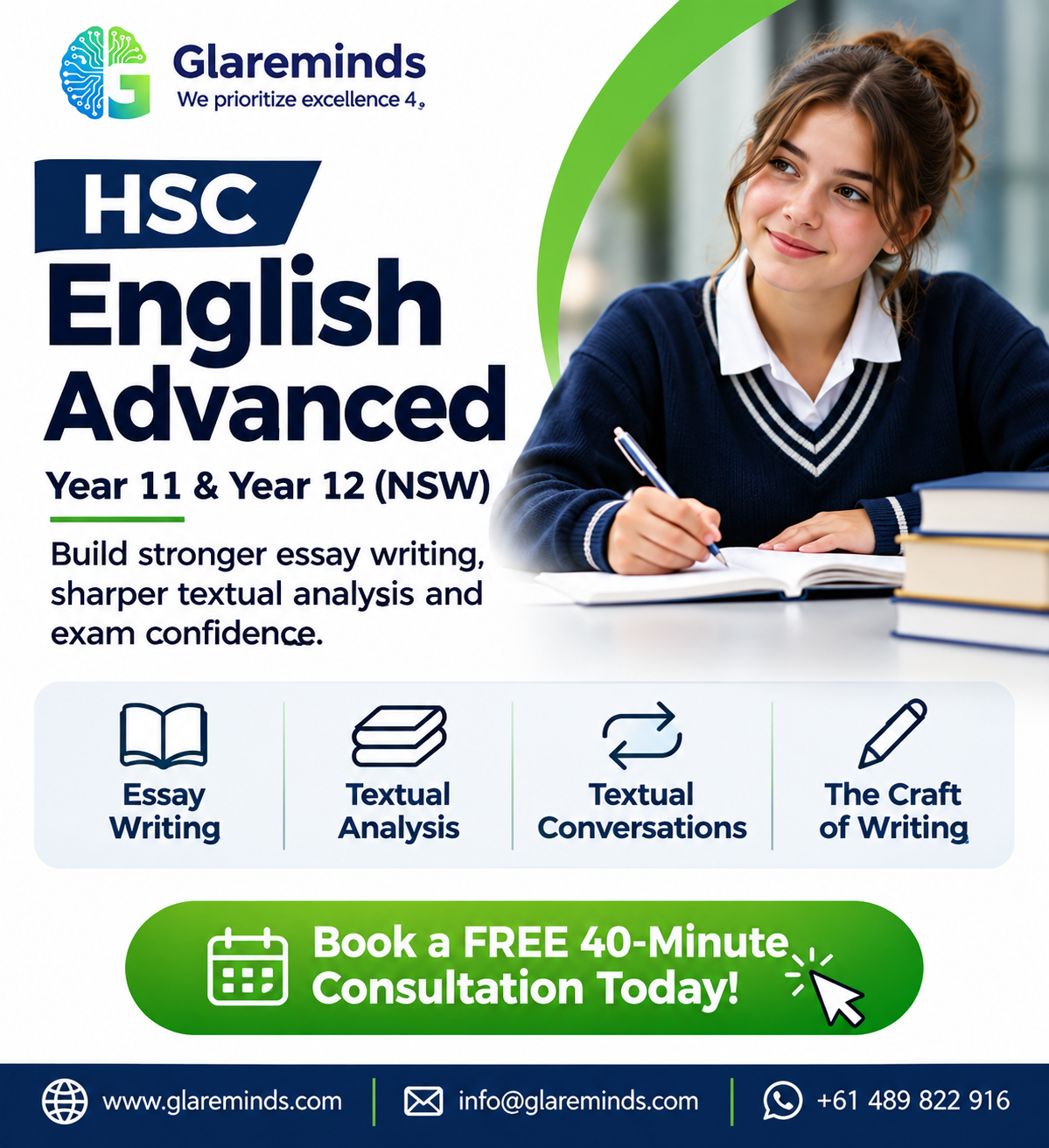
Is your child struggling with HSC English Advanced? Are they finding it difficult to analyse complex texts, write high-scoring essays or understand what examiners expect?
English Advanced is one of the most demanding senior secondary English courses in New South Wales. Students are expected to do much more than understand a story or memorise quotations. They must critically analyse literature, explore complex ideas, interpret language techniques and communicate sophisticated arguments through well-structured writing.
For many Year 11 and Year 12 students, the biggest challenge is learning how to transform their understanding of a text into a strong analytical response.
A student might understand a Shakespearean play but struggle to explain how the writer uses language to communicate meaning. Another may know several quotations from a prescribed text but find it difficult to connect them to an examination question.
These difficulties can affect confidence, assessment performance and overall HSC preparation.
At Glareminds, we understand that advanced English requires more than reading comprehension. Students need structured guidance, analytical thinking, strong writing skills and consistent practice.
Our personalised online English tutoring helps students develop the skills needed to approach challenging English assessments with greater confidence.
In this guide, we explore HSC English Advanced, the skills students need to master, common examination challenges and practical strategies for improving essay writing and textual analysis.
What Is HSC English Advanced?
HSC English Advanced is a two-unit senior secondary course developed by the NSW Education Standards Authority (NESA).
It is designed for students who have a particular interest and ability in English and want to develop advanced skills in reading, writing, critical analysis and communication.
The course exposes students to challenging literary and non-literary texts from different historical, cultural and social contexts.
Students develop the ability to:
- Analyse complex literary texts.
- Understand how language shapes meaning.
- Evaluate different perspectives and interpretations.
- Construct sophisticated written arguments.
- Compare texts and explore relationships between them.
- Compose creative, imaginative and analytical responses.
- Communicate effectively for different audiences and purposes.
English Advanced is particularly important for students considering university pathways that require strong communication, interpretation and analytical skills.
These may include law, humanities, journalism, education, communications and other fields.
Important: Understanding the New HSC English Advanced Syllabus
Parents and students should be aware that NSW is implementing a revised English Advanced syllabus.
The new English Advanced 11–12 Syllabus (2024) began implementation in 2026.
The new syllabus introduces focus areas in place of the previous module structure.
For students studying Year 12 under the new syllabus, the four focus areas are:
- Texts and Human Experiences.
- Textual Conversations.
- Critical Study of Literature.
- The Craft of Writing.
The new syllabus is scheduled for its first HSC examination in 2027.
Students completing the 2026 HSC continue under the outgoing 2017 syllabus, which uses the familiar Common Module and Modules A, B and C.
This distinction is important when choosing tutoring materials, revision resources and examination practice questions. Students should prepare according to the syllabus applicable to their cohort.
Source: NSW Department of Education and NESA.
1. HSC English Advanced Essay Writing: Why It Matters
Essay writing is one of the most important skills students need to develop in English Advanced.
A strong essay demonstrates that a student can understand a question, develop an argument, analyse textual evidence and communicate ideas logically.
Unfortunately, many students approach essay writing as a process of memorising prepared paragraphs.
This approach can become a problem when examination questions are worded differently from what they expected.
How to write a strong analytical introduction
An effective introduction should establish the central argument and directly address the question.
Students should avoid lengthy introductions that simply retell the story or provide unnecessary background information.
A good introduction should:
- Address the key terms in the question.
- Identify the central argument.
- Establish the text or texts being discussed.
- Introduce the main ideas that will be explored.
For example, if a question asks how a writer represents human experiences, students should explain what experiences are represented and how the writer's techniques communicate those ideas.
Developing strong body paragraphs
Each body paragraph should develop a particular aspect of the overall argument.
Students should understand how to:
- Introduce a clear analytical point.
- Provide relevant textual evidence.
- Identify the language or literary technique.
- Explain how the technique creates meaning.
- Connect the analysis to the question.
Simply identifying a metaphor, simile or symbol is not sufficient.
Students must explain why the technique matters and how it contributes to the writer's message.
Writing effective conclusions
A conclusion should reinforce the central argument and bring the discussion together.
Students should avoid introducing completely new ideas at this stage.
Instead, they should demonstrate how their analysis has answered the examination question.
2. Textual Analysis: Learning to Read Beyond the Surface
Textual analysis is a fundamental skill in HSC English Advanced.
Students are expected to understand not only what a writer communicates but also how and why meaning is created.
For example, consider the sentence:
"The city swallowed the last traces of daylight."
A student should recognise that the writer uses personification to present the city as an active force.
However, stronger analysis would explore how the image creates an atmosphere of darkness, uncertainty or isolation.
Students should develop their ability to analyse:
- Metaphors and similes.
- Symbolism.
- Imagery.
- Personification.
- Irony.
- Tone and mood.
- Narrative perspective.
- Structural techniques.
- Characterisation.
- Context and representation.
The goal is to move beyond identifying techniques towards explaining their effects.
How students can improve textual analysis
Encourage students to ask:
- What is the writer communicating?
- Why has this particular technique been used?
- What ideas or emotions does it create?
- How does the technique influence the reader?
- How does it connect to the broader themes of the text?
These questions encourage deeper thinking and more sophisticated written responses.
3. Understanding Textual Conversations
Textual Conversations is an important focus area in the new English Advanced syllabus.
It explores how texts communicate with, respond to and reinterpret other texts.
Students examine relationships between works, including how ideas, themes, values and perspectives are transformed across different contexts.
They may explore how a later writer revisits an earlier literary work and presents similar ideas from a different perspective.
Students need to understand:
- Relationships between texts.
- Historical and cultural contexts.
- Changes in values and perspectives.
- Similarities and differences in representation.
- The influence of context on meaning.
- How composers reinterpret established ideas.
For example, a contemporary adaptation of a Shakespearean play may preserve some central themes while changing the characters, setting or social perspectives.
Students should be able to explain not only what has changed but why those changes are significant.
Glareminds recommendation: Students should practise comparing texts through analytical paragraphs rather than writing separate summaries of each work.
4. Critical Study of Literature
Critical Study of Literature requires students to engage deeply with literary works.
Students must develop independent interpretations and support their arguments with appropriate textual evidence.
This goes beyond knowing the plot of a novel, play or collection of poems.
They should understand:
- Major themes.
- Character development.
- Narrative structure.
- Literary techniques.
- Historical and cultural contexts.
- Different critical interpretations.
- The relationship between form and meaning.
One common mistake is relying entirely on study notes or online summaries.
These resources may provide background information, but they cannot replace careful engagement with the actual text.
Students should read closely, annotate important passages and develop their own interpretations.
5. The Craft of Writing: Developing Original and Effective Responses
The Craft of Writing focuses on how students compose texts for different purposes, audiences and contexts.
Students need to develop both creative and critical writing skills.
This may involve composing imaginative, persuasive, discursive and reflective pieces.
Creative writing
Students should learn how to create engaging compositions through:
- Character development.
- Setting.
- Narrative voice.
- Imagery.
- Symbolism.
- Dialogue.
- Structural choices.
Discursive and persuasive writing
Students should also learn how to explore complex ideas, develop arguments and communicate different perspectives.
A strong response should demonstrate control over language, structure and tone.
Reflective writing
Students may also need to reflect on their creative decisions and explain how particular techniques communicate meaning.
The ability to explain why a particular writing choice was made is an important part of developing as a writer.
6. Why Do Students Struggle With HSC English Advanced?
Even academically capable students can find English Advanced challenging.
Some of the common difficulties include:
1. Memorising essays instead of understanding texts
Students sometimes prepare complete essays and attempt to reproduce them in examinations.
The problem is that examination questions can require a different argument or interpretation.
A memorised response may not adequately address the question.
Students should develop flexible arguments and understand their texts deeply enough to adapt their analysis.
2. Weak analytical writing
Some students can identify literary techniques but cannot explain their significance.
For example:
"The author uses imagery."
This is an observation, not a complete analytical explanation.
Students need to explain what the imagery communicates and how it contributes to the text's meaning.
3. Difficulty interpreting examination questions
English Advanced questions often contain specific instructions and conceptual terms.
Students must understand what the question requires before planning their response.
Misinterpreting a question can result in an otherwise well-written essay that does not adequately address the assessment.
4. Limited textual evidence
Students sometimes make broad arguments without supporting them with relevant quotations or textual references.
Strong analysis requires appropriate evidence.
However, students should not overload their essays with quotations. The important thing is to explain how selected evidence supports the argument.
5. Poor essay structure
An essay may contain excellent ideas but still be difficult to follow because its paragraphs lack logical progression.
Students should learn how to develop a coherent argument from the introduction through to the conclusion.
6. Limited vocabulary and expression
Students who repeatedly use the same words and sentence structures may struggle to communicate complex ideas effectively.
Reading widely and practising analytical writing can help develop stronger expression.
7. Time management difficulties
Students must balance planning, writing and reviewing within examination time limits.
Without sufficient practice, they may spend too long on introductions or individual paragraphs and struggle to complete their responses.
7. Seven Effective Ways to Improve HSC English Advanced Results
Students can improve their English performance through consistent practice and targeted learning.
Here are seven strategies worth implementing.
1. Read prescribed texts carefully
Students should engage directly with their prescribed texts rather than relying entirely on summaries.
They should annotate significant passages, identify important themes and consider how writers communicate meaning.
2. Develop a quotation and evidence bank
Create organised notes containing relevant quotations, textual references, techniques and interpretations.
Arrange the evidence according to themes, characters and important concepts.
This makes revision more organised and helps students select appropriate evidence when answering examination questions.
3. Practise writing analytical paragraphs
Rather than immediately attempting complete essays, practise developing strong body paragraphs.
Focus on making clear arguments, integrating evidence and explaining techniques.
4. Learn to adapt arguments to different questions
Choose different practice questions relating to the same text.
Encourage students to develop new arguments rather than repeating memorised paragraphs.
5. Improve vocabulary through regular reading
Read quality literature, editorials, essays and other well-written material.
Pay attention to how experienced writers communicate complex ideas.
Students should learn to use precise vocabulary naturally rather than forcing sophisticated words into every sentence.
6. Practise timed assessments
Regularly complete examination-style responses under timed conditions.
Review the answers afterwards to identify weaknesses in argument development, textual analysis, structure and expression.
7. Obtain constructive feedback
Feedback should explain what is working, what needs improvement and how to improve it.
Simply receiving a mark is not enough.
Students benefit from understanding why a particular response is effective or where their analysis needs greater depth.
8. Does Your Child Need an HSC English Advanced Tutor?
Not every student requires private English tutoring.
However, additional support may be beneficial when a student repeatedly struggles with particular aspects of the course.
Consider additional tutoring if your child:
- Finds analytical essay writing difficult.
- Struggles to interpret examination questions.
- Has difficulty analysing literary techniques.
- Cannot develop sophisticated arguments.
- Relies heavily on memorised essays.
- Finds textual comparisons challenging.
- Has difficulty with creative and discursive writing.
- Receives lower assessment marks than expected.
- Needs individual feedback on written responses.
- Lacks confidence when preparing for HSC examinations.
A good English tutor should not simply provide model essays for students to memorise.
They should help students develop the ability to interpret questions, understand texts, construct arguments and communicate their ideas independently.
For some students, the biggest challenge is essay structure. For others, it is understanding literary concepts or developing stronger analytical arguments.
Personalised instruction makes it possible to concentrate on the areas that require the most attention.
9. How Glareminds Helps HSC English Advanced Students
At Glareminds, we provide personalised one-to-one online tutoring for secondary school students preparing for challenging academic assessments.
We understand that English Advanced requires a combination of critical thinking, reading comprehension, literary interpretation and strong written communication.
Our tutoring approach focuses on helping students become independent and confident learners.
Our English support can include:
Analytical essay writing: Developing structured arguments, stronger introductions, effective body paragraphs and meaningful conclusions.
Textual analysis: Understanding literary techniques, interpreting complex passages and explaining how writers create meaning.
Textual comparisons: Exploring relationships between texts, contexts, themes and perspectives.
Creative and discursive writing: Improving composition skills, expression, structure and originality.
Examination preparation: Practising assessment questions, improving time management and developing effective examination techniques.
Individual feedback: Identifying weaknesses in written responses and providing constructive guidance for improvement.
Why Choose One-to-One Tutoring?
Every student has different academic strengths and weaknesses.
In a classroom, teachers must accommodate multiple learners. Individual tutoring provides an opportunity to concentrate on the specific areas where a student needs help.
At Glareminds, our approach includes:
- Personalised lessons based on individual learning needs.
- Experienced tutors familiar with different international curricula.
- Clear explanations of challenging English concepts.
- Structured essay-writing practice.
- Regular feedback and improvement guidance.
- Flexible online learning from home.
Our UK-trained Nigerian tutors bring experience across British, Australian, Canadian and other international curricula.
We work with families across Sydney, Melbourne, Brisbane, Perth and other locations who want additional academic support for their children.
Whether your child is in Year 11 or Year 12, we can help explore a tutoring programme aligned with their current syllabus and learning objectives.
10. Give Your Child the Academic Support Needed to Approach the HSC With Confidence
HSC English Advanced can be challenging, but students do not have to approach those challenges without guidance.
Strong analytical writing, careful reading, effective textual interpretation and consistent practice can make a significant difference to academic development.
If your child is struggling with essay writing, textual analysis or examination preparation, identifying the difficulty early can help prevent it from affecting their confidence and overall performance.
At Glareminds, we want to help students move beyond memorising essays and develop the ability to think critically, communicate effectively and respond confidently to complex questions.
Book a FREE 40-minute consultation with Glareminds.
During the consultation, we can discuss:
- Your child's current English Advanced performance.
- Areas of difficulty in reading and writing.
- Essay-writing and textual analysis skills.
- Their current syllabus and assessment requirements.
- Suitable personalised tutoring options.
Give your child the opportunity to strengthen their English skills and approach their HSC preparation with greater confidence.
Explore our tutoring services:
Contact Glareminds to discuss personalised English tutoring for Year 11 and Year 12 students in Australia.
Glareminds – Building Strong Academic Foundations, One Learner at a Time.
Frequently Asked Questions About HSC English Advanced
1. What is HSC English Advanced?
HSC English Advanced is a two-unit senior secondary English course in New South Wales. It develops students' abilities in critical reading, textual analysis, creative composition and advanced written communication.
2. Is HSC English Advanced difficult?
Many students find it challenging because it requires independent interpretation, sophisticated essay writing and the ability to analyse complex texts. Consistent reading, writing practice and constructive feedback can help students improve.
3. What topics are covered in HSC English Advanced?
Under the new 2024 syllabus, the Year 12 focus areas are Texts and Human Experiences, Textual Conversations, Critical Study of Literature and The Craft of Writing. The applicable syllabus depends on the student's cohort.
4. What is the difference between English Standard and English Advanced?
English Advanced is designed for students who want to engage with more challenging texts and develop deeper critical and analytical skills. English Standard also develops important literacy and communication skills but has different course expectations and content.
5. How can I improve my HSC English Advanced essay writing?
Practise interpreting questions, developing clear arguments, integrating textual evidence and explaining literary techniques. Seek feedback on your paragraphs and complete timed essay exercises.
6. Do I need to memorise essays for HSC English Advanced?
Memorising complete essays is generally not a reliable strategy because examination questions can vary. It is more effective to understand prescribed texts, develop flexible arguments and prepare relevant textual evidence.
7. How important are quotations in HSC English Advanced?
Quotations provide evidence for analytical arguments. However, students must explain their significance and connect them to the question rather than simply inserting quotations without analysis.
8. Can private tutoring improve HSC English Advanced performance?
Personalised tutoring can help students identify weaknesses, improve essay structure, develop analytical skills and receive detailed feedback on their writing. Results depend on the student's effort, consistency and quality of instruction.
9. Can Glareminds provide online HSC English Advanced tutoring?
Yes. Glareminds provides personalised online academic tutoring for students across Australia, including learners preparing for senior secondary English assessments in New South Wales.
10. When should a student start HSC English Advanced tutoring?
Students can benefit from additional support during Year 11, particularly when developing analytical writing and textual understanding. Year 12 students may also benefit from focused examination preparation and feedback on practice responses.
Help Your Child Develop Stronger HSC English Skills
Strong English skills extend beyond the HSC examination. They help students communicate ideas, interpret information, think critically and succeed in further education.
If your child needs additional support with HSC English Advanced, Glareminds is ready to help.
Book your free 40-minute consultation today.
Visit https://glareminds.com and discover personalised online tutoring for Australian students.