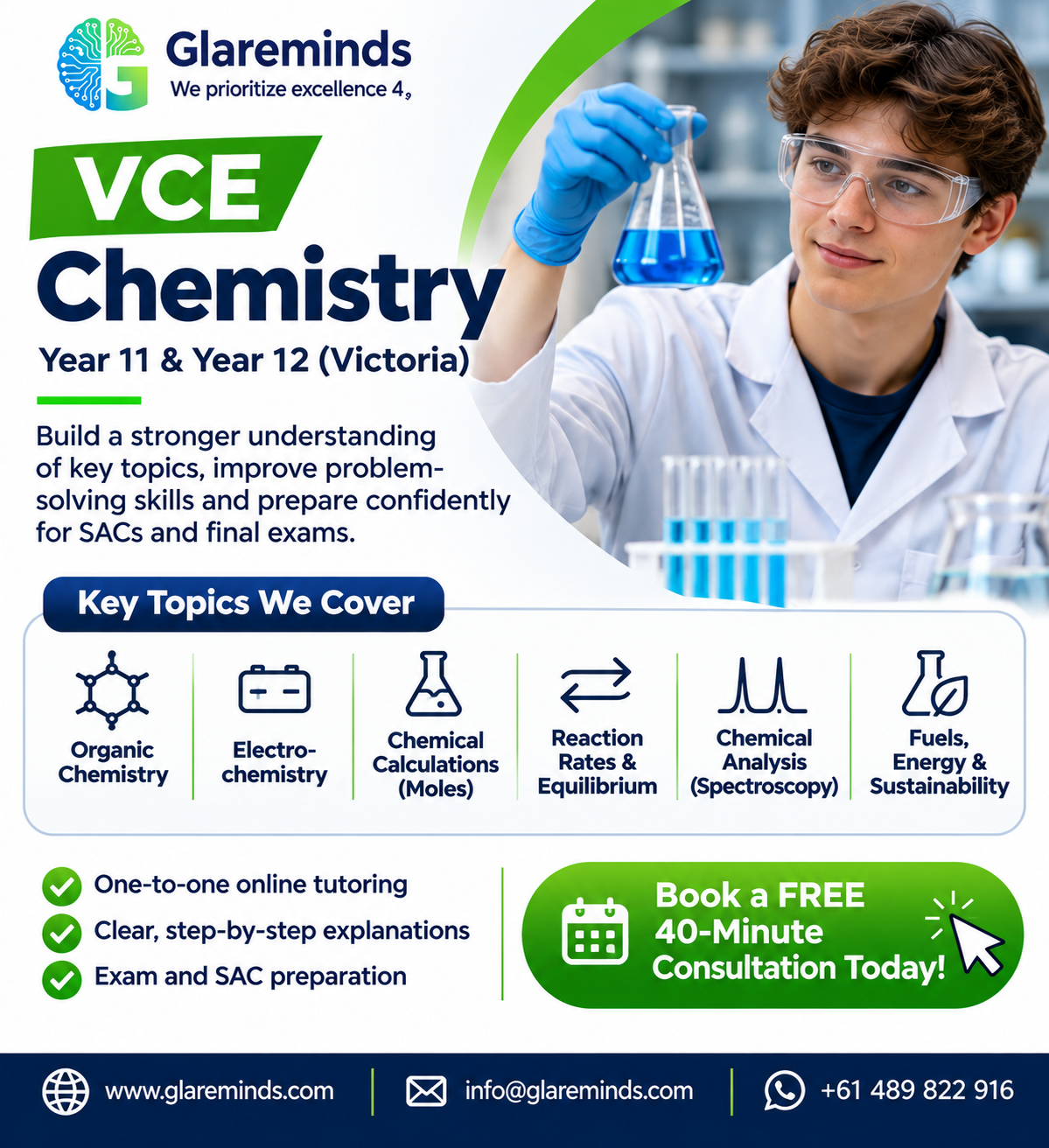
Is your child struggling with VCE Chemistry? Are they finding organic chemistry, electrochemistry, chemical calculations or practical investigations difficult to understand?
For many students in Victoria, VCE Chemistry is one of the most challenging senior secondary science subjects. It requires more than remembering chemical equations or learning definitions. Students must understand chemical principles, interpret experimental data, perform calculations, explain reactions and apply scientific knowledge to unfamiliar situations.
The challenges often become more noticeable in Year 12, when students encounter more advanced concepts and prepare for School-assessed Coursework (SACs) and the final VCAA examination.
A student might understand the theory of chemical reactions but struggle to calculate reaction quantities. Another may know the rules of organic chemistry but find it difficult to identify an unknown compound using analytical data.
These difficulties can affect academic confidence and examination performance.
At Glareminds, we understand that Chemistry requires clear explanations, strong scientific foundations and consistent practice. Our personalised online tutoring helps students understand difficult concepts, strengthen problem-solving skills and prepare more confidently for assessments.
In this guide, we examine the VCE Chemistry curriculum, difficult topics students should master, common learning challenges and practical ways parents can support their children's academic progress.
What Is VCE Chemistry?
VCE Chemistry is a senior secondary science subject offered under the Victorian Certificate of Education (VCE).
It enables students to investigate the properties of chemicals, understand chemical reactions and explore how chemistry is applied in everyday life, industry, medicine, energy production and environmental sustainability.
The subject develops students' abilities in:
- Chemical calculations.
- Scientific investigation.
- Laboratory techniques.
- Chemical analysis.
- Interpretation of experimental data.
- Problem-solving.
- Critical and scientific reasoning.
The VCE Chemistry Study Design currently covers four units.
UnitMain focusUnit 1How can the diversity of materials be explained?Unit 2How do chemical reactions shape the natural world?Unit 3How can design and innovation help to optimise chemical processes?Unit 4How are carbon-based compounds designed for purpose?
For students in Year 12, Units 3 and 4 are particularly important because they contribute to the final VCE Chemistry study score.
The current accreditation period for Units 3 and 4 is 2024–2027.
Why Do Students Find VCE Chemistry Difficult?
Chemistry combines theoretical understanding, mathematical calculations and practical scientific skills.
Students who are comfortable with one aspect may struggle with another.
Here are some common reasons.
1. Difficulty understanding abstract chemical concepts
Chemistry involves processes that cannot always be observed directly.
For example, students must understand how atoms interact, how electrons are transferred and how chemical bonds influence the properties of substances.
Without a strong conceptual foundation, students may find it difficult to explain why chemical reactions occur.
2. Weak mathematical foundations
Some Chemistry topics require students to perform calculations involving moles, concentrations, reaction quantities and energy changes.
A student may understand the scientific principle but lose marks because of mathematical errors or incorrect unit conversions.
3. Difficulty connecting theory with practical experiments
Chemistry is an experimental science.
Students are expected to understand how laboratory investigations generate evidence and how experimental results support scientific conclusions.
Simply memorising experimental procedures is not enough.
Students must understand the purpose of an experiment, identify variables, interpret results and evaluate limitations.
4. Difficulty interpreting unfamiliar questions
VCE examination questions often require students to apply knowledge in unfamiliar situations.
A student who understands a topic may still struggle when the question presents new experimental data, chemical structures or real-world scenarios.
5. Poor examination preparation
Some students spend too much time reading notes and memorising definitions without practising calculations, data interpretation and extended-response questions.
Effective preparation requires a combination of conceptual learning and application.
Important VCE Chemistry Topics Students Should Master
Understanding the major areas of the VCE Chemistry curriculum is essential for effective preparation.
The following topics deserve particular attention.
1. Chemical Calculations and the Mole Concept
The mole concept is one of the most important foundations in Chemistry.
Students use it to connect the microscopic world of atoms and molecules with measurable quantities in the laboratory.
Important skills include:
- Calculating molar mass.
- Converting between mass and moles.
- Understanding Avogadro's constant.
- Using balanced chemical equations.
- Performing stoichiometric calculations.
- Calculating solution concentrations.
- Interpreting quantitative experimental data.
For example:
If a student has 18 grams of water and the molar mass of water is 18 grams per mole:
[
n=\frac{m}{M}
]
[
n=\frac{18}{18}=1\text{ mol}
]
Students should understand why the formula works and how to apply it in different situations.
Why students struggle: Many students memorise calculation procedures without understanding the relationship between mass, molar mass and the number of particles.
How to improve: Practise different question types and learn to identify the information provided, the quantity required and the appropriate equation.
2. Electrochemistry and Electrochemical Cells
Electrochemistry is an important area of VCE Chemistry.
It examines the relationship between chemical reactions and electrical energy.
Students investigate how chemical energy can be converted into electrical energy and how electricity can drive chemical reactions.
Important concepts include:
- Oxidation and reduction.
- Electron transfer.
- Oxidation numbers.
- Electrochemical series.
- Galvanic cells.
- Fuel cells.
- Electrolysis.
- Rechargeable batteries.
Understanding oxidation and reduction
Students should understand that oxidation involves the loss of electrons, while reduction involves the gain of electrons.
A useful way to remember this is:
- Oxidation: Loss of electrons.
- Reduction: Gain of electrons.
Students must also understand how oxidation and reduction occur together in a redox reaction.
Understanding galvanic cells
A galvanic cell uses a spontaneous redox reaction to generate electrical energy.
Students should be able to identify:
- The anode.
- The cathode.
- Electron flow.
- Ion movement.
- Oxidation and reduction reactions.
Understanding electrolysis
Electrolysis uses electrical energy to drive a non-spontaneous chemical reaction.
Students should understand the movement of ions, the reactions occurring at electrodes and how electrical energy is used to produce chemical substances.
Why students struggle: Electrochemistry combines abstract electron movement, chemical equations and practical applications.
How to improve: Use labelled diagrams, practise identifying oxidation and reduction reactions and work through electrochemical calculations step by step.
3. Chemical Reaction Rates and Equilibrium
Students must understand how and why chemical reactions occur at different rates.
They also need to understand the factors that influence the extent of chemical reactions and the conditions under which equilibrium is established.
Important areas include:
- Reaction rates.
- Collision theory.
- Activation energy.
- Catalysts.
- Concentration.
- Temperature.
- Surface area.
- Chemical equilibrium.
- Le Chatelier's principle.
Collision theory
Collision theory explains that chemical reactions occur when particles collide with sufficient energy and the correct orientation.
Students should understand how temperature, concentration and surface area influence collision frequency and reaction rates.
Le Chatelier's principle
Le Chatelier's principle explains how an equilibrium system responds when conditions change.
For example, changing temperature, pressure or concentration may shift the position of equilibrium.
Students should be able to predict and explain the direction of these changes.
Why students struggle: Some students can state the principles but cannot explain how they apply to an unfamiliar chemical system.
How to improve: Practise interpreting equilibrium scenarios and explaining the scientific reasons behind predicted changes.
4. Organic Chemistry and Carbon-Based Compounds
Organic chemistry is a significant area of VCE Chemistry, particularly in Unit 4.
Students investigate carbon-based compounds, their structures, properties, reactions and applications.
Important areas include:
- Hydrocarbons.
- Alkanes and alkenes.
- Alcohols.
- Carboxylic acids.
- Esters.
- Functional groups.
- Structural formulas.
- Organic reactions.
- Organic synthesis.
Understanding functional groups
Functional groups determine many of the characteristic chemical properties of organic compounds.
Students should become familiar with the structures and properties of the major organic families covered in the study design.
Naming organic compounds
Students should understand how to identify and name organic compounds using systematic nomenclature.
They should also be able to interpret structural formulas and recognise differences between related compounds.
Organic reaction pathways
Students may need to understand how one organic compound can be transformed into another through a sequence of chemical reactions.
This requires knowledge of reaction types, reagents and the structures of products.
Why students struggle: Organic chemistry contains many related structures and reaction pathways that students can easily confuse.
How to improve: Create organised reaction maps, practise drawing structures and learn to identify functional groups before attempting more complex synthesis questions.
5. Chemical Analysis and Instrumental Techniques
Chemical analysis is important because scientists need to identify substances and determine their composition.
Students should understand how analytical techniques provide information about unknown compounds.
Depending on the relevant study-design content, this includes techniques such as:
- Chromatography.
- Infrared spectroscopy.
- Nuclear magnetic resonance spectroscopy.
- Mass spectrometry.
- Chemical testing.
- Quantitative analysis.
Infrared spectroscopy
Infrared spectroscopy provides information about the bonds and functional groups present in an organic compound.
Students should learn how to interpret relevant absorption features and use them to identify possible structures.
Nuclear magnetic resonance spectroscopy
NMR spectroscopy provides information about the chemical environments of certain atomic nuclei.
Students need to understand how spectral information can help determine the structure of an organic molecule.
Mass spectrometry
Mass spectrometry provides information about the masses of ions and can help identify molecular and structural characteristics.
Students should practise interpreting relevant data rather than simply memorising definitions.
Why students struggle: Analytical questions require students to connect experimental evidence with chemical structures.
How to improve: Practise interpreting spectra, identifying significant features and explaining how the evidence supports a particular conclusion.
6. Fuels, Energy and Sustainability
Students investigate how different fuels provide energy and how their production and use affect the environment.
Important concepts include:
- Combustion reactions.
- Energy released by fuels.
- Quantitative fuel comparisons.
- Greenhouse gas emissions.
- Electrochemical energy storage.
- Fuel cells.
- Sustainable energy technologies.
Students should understand how energy can be obtained from different fuels and evaluate their advantages and disadvantages.
They should also be able to compare fuels quantitatively using relevant chemical information.
Why students struggle: Students sometimes memorise environmental advantages and disadvantages without understanding the underlying chemistry.
How to improve: Connect fuel chemistry with combustion equations, energy calculations and evidence-based sustainability comparisons.
7. Food Chemistry and Biomolecules
Unit 4 also explores important organic compounds found in food and their role in the human body.
Students develop an understanding of molecules such as:
- Carbohydrates.
- Proteins.
- Lipids.
They investigate their structures, chemical properties and roles in biological processes.
Students should also understand how food molecules contribute to energy production and how chemical analysis can be used to investigate food composition.
Why students struggle: Students may understand the biological purpose of food molecules but find it difficult to connect this knowledge with chemical structures and reactions.
How to improve: Practise drawing and identifying structures, comparing molecular properties and explaining relevant chemical processes.
8. Scientific Investigations and Laboratory Skills
Scientific investigation is an essential part of VCE Chemistry.
Students must be able to design experiments, collect data, analyse findings and communicate scientific conclusions.
Important skills include:
- Formulating research questions.
- Developing hypotheses.
- Identifying variables.
- Designing experimental procedures.
- Collecting accurate measurements.
- Recording observations.
- Analysing results.
- Evaluating experimental limitations.
- Communicating scientific findings.
Students also complete a student-designed scientific investigation as part of the Unit 4 assessment requirements.
They should understand how to present their work through an appropriate scientific poster and supporting documentation.
Why students struggle: Some students focus heavily on theoretical Chemistry and underestimate the importance of practical scientific skills.
How to improve: Maintain a well-organised laboratory logbook, understand experimental procedures and practise evaluating the reliability and limitations of results.
How Is VCE Chemistry Assessed?
Understanding the assessment structure is important for effective examination preparation.
For Units 3 and 4, VCAA assessment includes School-assessed Coursework and an external end-of-year examination.
Assessment componentContribution to study scoreSchool-assessed Coursework (SACs)50%End-of-year examination50%
The five prescribed SAC tasks across Units 3 and 4 assess different aspects of Chemistry knowledge and scientific skills.
These include problem-solving, analysis of data, evaluation of chemical innovations and scientific investigation.
This means students should not concentrate exclusively on the final examination.
They should develop strong theoretical understanding, practical investigation skills and the ability to communicate scientific findings throughout the course.
Why Do Some Students Perform Below Their Expected Level in VCE Chemistry?
A student may understand Chemistry reasonably well but still receive disappointing assessment results.
Several factors can contribute.
1. Memorising instead of understanding
Students sometimes learn definitions and equations without understanding the chemical principles behind them.
This makes it difficult to apply knowledge to unfamiliar questions.
2. Weak calculation techniques
Errors in rearranging equations, converting units or interpreting numerical information can affect performance across several topics.
3. Poor interpretation of command words
Students should understand what assessment instructions require.
For example:
- Identify: Recognise or name something.
- Describe: Provide relevant characteristics.
- Explain: Show why or how something occurs.
- Analyse: Examine information and identify relationships.
- Evaluate: Make a judgement using relevant evidence.
Understanding these instructions helps students provide answers at the appropriate level of detail.
4. Inadequate practical preparation
Students who do not understand laboratory methods may struggle with questions involving experimental data, accuracy, precision and limitations.
5. Limited examination practice
Reading notes is not the same as answering examination questions.
Students need to practise calculations, structured responses and data interpretation under appropriate time conditions.
Seven Effective Ways to Prepare for VCE Chemistry Exams
1. Build a strong foundation in chemical calculations
Revise the mole concept, molar mass, concentration and stoichiometry.
These skills are used in several areas of Chemistry.
2. Understand chemical reactions visually
Use diagrams to understand electrochemical cells, electron movement, organic structures and reaction pathways.
Visual learning can make abstract concepts easier to understand.
3. Create topic-based revision notes
Organise notes according to the current VCAA study design.
Include definitions, equations, diagrams, worked examples and common mistakes.
4. Practise VCAA examination questions
Use official past examination papers and reports to become familiar with the question styles and expectations.
Do not simply memorise previous answers. Understand why particular responses are effective.
5. Review SAC feedback
After each SAC, identify the topics and skills where marks were lost.
Use this information to guide revision.
6. Practise scientific data interpretation
Work with graphs, tables, experimental results and chemical information.
Learn how to explain patterns and support conclusions using evidence.
7. Seek help when a topic becomes difficult
Do not allow misunderstandings to accumulate.
If a student struggles with electrochemistry, organic chemistry or calculations, additional explanation and targeted practice may be useful before the next assessment.
Does Your Child Need a VCE Chemistry Tutor?
Not every student needs private tutoring to succeed in VCE Chemistry.
However, additional support can be valuable when a student repeatedly struggles with specific topics or needs more individual attention.
Consider a VCE Chemistry tutor if your child:
- Finds organic chemistry difficult.
- Struggles with electrochemical cells and redox reactions.
- Has difficulty with mole calculations and stoichiometry.
- Cannot confidently interpret experimental data.
- Finds chemical equilibrium confusing.
- Struggles with spectroscopy and chemical analysis.
- Has difficulty preparing for SAC assessments.
- Understands lessons but performs poorly in examinations.
- Needs support with scientific investigations.
- Lacks confidence when approaching unfamiliar Chemistry questions.
The important thing is to identify the underlying learning difficulty.
For example, a student struggling with electrochemical calculations may need help with mathematical foundations and chemical equations.
A student struggling with organic chemistry may need more structured support with functional groups, nomenclature and reaction pathways.
A good tutor should address these specific difficulties rather than simply provide additional worksheets.
How Glareminds Helps VCE Chemistry Students in Victoria
At Glareminds, we provide personalised one-to-one online Chemistry tutoring for secondary school students.
We understand that VCE Chemistry requires strong conceptual understanding, accurate calculations and the ability to apply scientific knowledge to practical situations.
Our tutoring approach focuses on helping students understand difficult topics rather than memorising isolated information.
Our Chemistry tutoring can support students with:
Chemical calculations: Understanding the mole concept, stoichiometry, concentration and quantitative problem-solving.
Electrochemistry: Explaining redox reactions, electrochemical cells, fuel cells and electrolysis.
Chemical reactions: Developing understanding of reaction rates, equilibrium and chemical processes.
Organic chemistry: Learning functional groups, structures, nomenclature and organic reaction pathways.
Chemical analysis: Understanding spectroscopy, chromatography and the interpretation of analytical data.
Examination preparation: Practising VCE-style questions, improving calculation accuracy and developing structured scientific explanations.
Individual academic support: Identifying learning gaps and creating lessons that address each student's specific needs.
Why Choose Personalised One-to-One Tutoring?
Every student learns differently.
Some students need additional explanations of difficult scientific concepts, while others require more practice with calculations or examination questions.
One-to-one tutoring allows lessons to focus on these individual requirements.
At Glareminds, we prioritise:
- Individual attention.
- Personalised learning plans.
- Clear explanations of complex Chemistry topics.
- Structured examination practice.
- Regular feedback.
- Strong scientific foundations.
- Flexible online lessons.
Our UK-trained Nigerian tutors bring experience across different international curricula.
We work with families in Melbourne, Geelong, Ballarat, Bendigo, Shepparton and other parts of Victoria who want additional academic support for their children.
With online tutoring, students can receive personalised lessons from home without travelling to a physical tutoring centre.
Give Your Child the Chemistry Support They Need Before Final Examinations
VCE Chemistry becomes more manageable when students understand the concepts, practise consistently and receive guidance on areas where they need improvement.
If your child is struggling with organic chemistry, electrochemistry, chemical calculations or scientific investigations, it is worth identifying those difficulties early.
At Glareminds, we can help you understand your child's learning needs and explore a suitable tutoring programme.
Book a FREE 40-minute consultation with Glareminds.
During the consultation, we can discuss:
- Your child's current Chemistry performance.
- The topics they find most difficult.
- Their SAC and examination preparation needs.
- Areas requiring additional explanation.
- Suitable personalised tutoring options.
Give your child the opportunity to strengthen their Chemistry knowledge, improve problem-solving skills and approach VCE assessments with greater confidence.
Explore our tutoring services:
Australian tutoring services:
https://glareminds.com/australian-school-exam-preparation-tutors.php
Glareminds – Building Strong Academic Foundations, One Learner at a Time.
Frequently Asked Questions About VCE Chemistry
1. Is VCE Chemistry difficult?
VCE Chemistry can be challenging because it combines theoretical concepts, mathematical calculations, practical investigations and scientific reasoning. Students who develop strong foundations and practise consistently can improve their understanding.
2. What topics are covered in VCE Chemistry Units 3 and 4?
Unit 3 focuses on energy, fuels, electrochemical processes, reaction rates and optimising chemical processes. Unit 4 focuses on organic compounds, their structures, reactions, analysis, applications and scientific investigation.
3. How is VCE Chemistry assessed?
For Units 3 and 4, School-assessed Coursework contributes 50% of the study score, while the end-of-year examination contributes the remaining 50%.
4. What is the mole concept in Chemistry?
The mole is a unit used to measure the amount of a substance. It allows students to connect the number of particles in a substance with measurable quantities such as mass.
5. Why is organic chemistry difficult for some VCE students?
Organic chemistry involves understanding carbon-based structures, functional groups, nomenclature and chemical reactions. Students may struggle when they attempt to memorise reaction pathways without understanding the underlying chemical principles.
6. How can I improve my VCE Chemistry examination results?
Develop a strong understanding of the study-design content, practise calculations, complete past examination questions, review SAC feedback and work on interpreting experimental data.
7. Are practical experiments important in VCE Chemistry?
Yes. Practical work develops scientific investigation skills and helps students understand how chemical knowledge is tested and applied. Students also need to understand experimental accuracy, precision, limitations and the interpretation of results.
8. Can a private tutor help with VCE Chemistry?
Yes. A qualified tutor can provide individual explanations, identify learning gaps, strengthen mathematical skills and help students practise examination-style questions.
9. Can Glareminds provide online VCE Chemistry tutoring?
Yes. Glareminds provides personalised online academic tutoring for students across Victoria and other parts of Australia.
10. When should students start preparing for VCE Chemistry examinations?
Preparation should begin throughout the school year rather than only a few weeks before the final examination. Students should review each topic regularly, address difficulties early and practise assessment questions consistently.
Help Your Child Build Confidence in Chemistry
Strong Chemistry skills are developed through understanding, practice and the ability to apply scientific knowledge.
If your child needs additional support with VCE Chemistry, Glareminds is ready to help.
Book your FREE 40-minute consultation today.
Visit https://glareminds.com and explore personalised online tutoring for Victorian students.