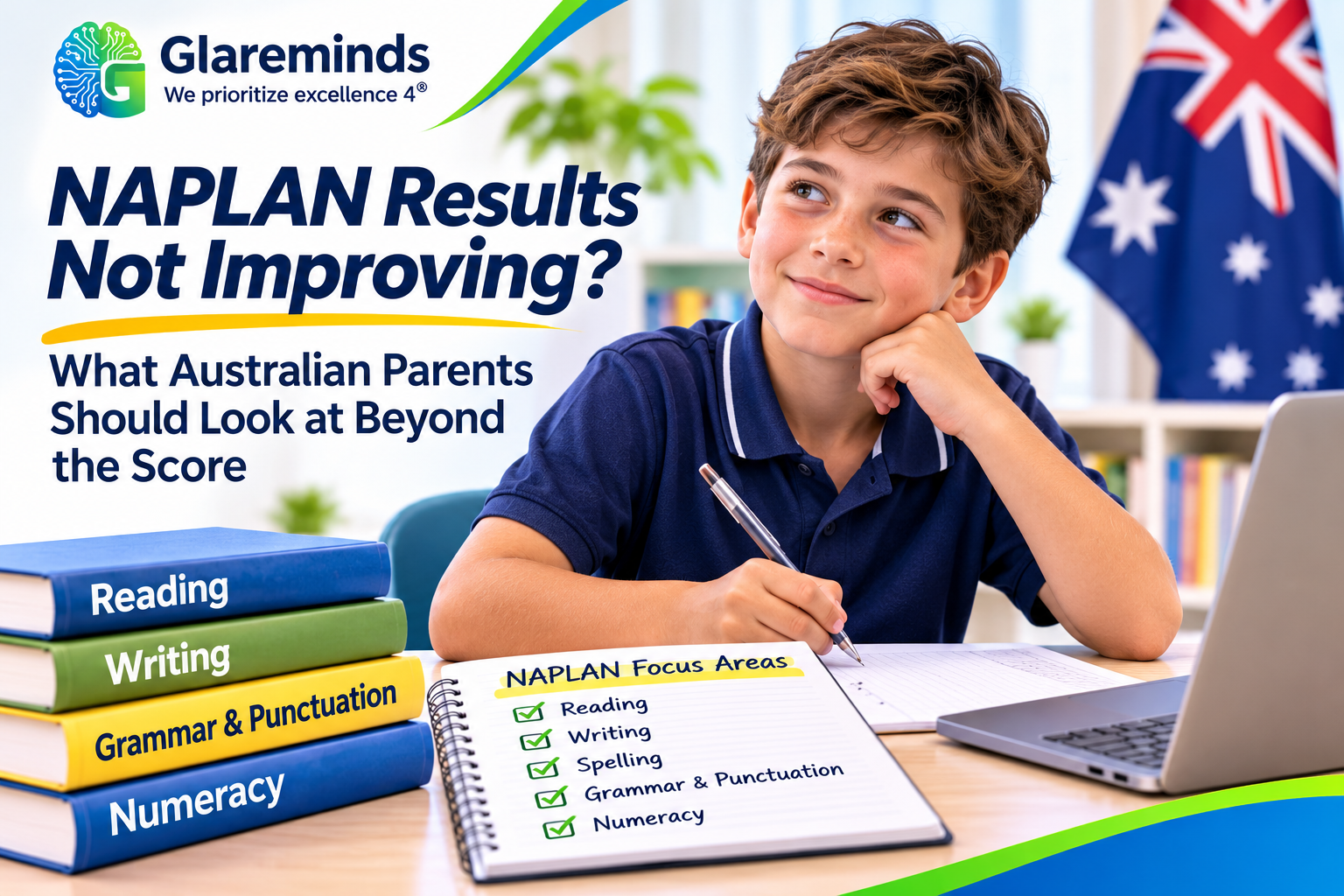
A practical guide for parents who want to understand their child's learning progress, identify academic weaknesses and provide the right support.
When NAPLAN results arrive and your child's performance has not improved as expected, it is natural to feel concerned.
Perhaps your child has been attending school regularly, completing homework and spending time studying, yet their results still indicate that they are working towards the expected standard. You may even have arranged extra lessons, purchased practice books or encouraged more revision without seeing the progress you hoped for.
The important question is this: Are you addressing the actual learning difficulties holding your child back, or are you simply asking them to do more work?
NAPLAN results can provide useful information about a child's literacy and numeracy development. However, the overall result does not always explain why a learner is struggling.
For Australian parents, the next step should be to look beyond the result and understand the specific skills their child needs to develop.
At Glareminds, we believe that effective academic support begins with understanding the learner, identifying gaps and creating a learning plan that addresses those needs.
1. Understand what your child's NAPLAN result actually means
NAPLAN assesses students in Years 3, 5, 7 and 9 across five areas:
- Reading
- Writing
- Spelling
- Grammar and punctuation
- Numeracy
Since 2023, NAPLAN results have been reported using four proficiency levels:
- Exceeding: The student has demonstrated achievement above the expected standard.
- Strong: The student has demonstrated achievement that meets the expected standard.
- Developing: The student is working towards the expected standard.
- Needs additional support: The student requires further support to achieve the expected learning outcomes.
NAPLAN is not a pass-or-fail examination. It is designed to provide information about student achievement and help identify areas where additional support or greater academic challenge may be appropriate.
This distinction matters because a child in the Developing category is not necessarily incapable of understanding the subject. They may have particular weaknesses that need to be addressed.
For example, a student may understand basic multiplication but struggle with multi-step word problems. Another may read fluently but find it difficult to identify the main argument in an unfamiliar passage.
These are different learning needs and require different teaching approaches.
2. Look at individual learning areas rather than the overall result
One of the most common mistakes parents make is focusing entirely on the general NAPLAN outcome.
A child may perform reasonably well in reading but struggle with writing. Another may demonstrate good number skills but find measurement, geometry or mathematical reasoning difficult.
Instead of asking only whether the result improved, examine each assessment area separately.
Numeracy: Is your child struggling with mathematical understanding?
Numeracy difficulties can appear in several ways.
Your child may:
- Understand addition and subtraction but struggle with multiplication and division.
- Have difficulty working with fractions, decimals and percentages.
- Struggle to interpret mathematical word problems.
- Find measurement, time, area and volume confusing.
- Have difficulty identifying patterns and relationships.
- Know mathematical procedures but struggle to explain their reasoning.
For example, a Year 7 learner may know how to calculate 25% of 80 when the question is presented directly.
However, when asked to solve a real-life problem involving discounts, prices and percentages, the learner may become confused.
This suggests that the difficulty may not simply be calculation. It could involve interpreting the question, identifying the appropriate operation and applying mathematical knowledge.
A tutor should investigate these underlying skills rather than repeatedly assigning similar exercises.
Reading: Can your child understand what they read?
Reading is more than recognising words and reading sentences aloud.
A learner may read a passage confidently but struggle to:
- Identify the main idea.
- Recognise supporting details.
- Make inferences from information in a passage.
- Understand unfamiliar vocabulary through context.
- Identify an author's purpose.
- Compare information across different texts.
For example, a student may understand what a passage says directly but struggle when asked what the author implies.
This distinction between literal understanding and inference is important as reading tasks become more demanding in the upper primary and secondary years.
Writing: Can your child organise and communicate ideas?
Some learners have good ideas but struggle to communicate them effectively in writing.
Look at whether your child can:
- Organise ideas into logical paragraphs.
- Write clear and complete sentences.
- Use appropriate punctuation.
- Apply correct grammar.
- Develop an argument or explanation.
- Select vocabulary suitable for the purpose and audience.
- Review and improve their written work.
A child who writes lengthy responses is not automatically demonstrating strong writing skills. Organisation, clarity, sentence structure and relevance are equally important.
Spelling, grammar and punctuation
These skills are sometimes overlooked because parents concentrate on mathematics and reading.
However, persistent difficulties with spelling, sentence construction, punctuation and grammar can affect written communication and performance across several subjects.
The important thing is to identify whether the problem is caused by a lack of understanding, limited practice, careless errors or difficulty applying the rules independently.
3. Check whether your child has gaps in earlier learning
A child struggling in Year 7 may not necessarily have developed the difficulty in Year 7.
Sometimes, the problem started several years earlier.
For example, a student who struggles with fractions may have an incomplete understanding of multiplication, division or equivalent fractions.
A learner who finds algebra difficult may still be struggling with basic number relationships and mathematical operations.
This is why simply teaching the current school topic may not be enough.
A good tutor should investigate the foundation behind the topic.
Consider this example:
A student struggles with fractions.
Rather than immediately moving to more difficult fraction exercises, the tutor should check whether the learner understands:
- What the numerator and denominator represent.
- Equivalent fractions.
- Simplifying fractions.
- Comparing fractions.
- Multiplication and division of fractions.
- Applying fractions to word problems.
If the learner has difficulty with equivalent fractions, moving directly to more advanced operations may create further confusion.
The objective should be to repair the foundation before introducing more demanding work.
4. Find out whether your child can work independently
A child may appear to understand a topic during lessons but struggle when asked to complete similar questions independently.
This is an important distinction.
When a teacher or parent explains a question, the learner receives guidance. They may understand the explanation and follow the demonstrated steps.
However, when faced with a new question, they may not know how to begin.
Ask yourself:
- Can my child solve similar questions without assistance?
- Can they explain why they chose a particular method?
- Can they apply what they learned to a different question?
- Can they identify and correct their own mistakes?
- Can they complete homework without constant supervision?
If the answer to most of these questions is no, your child may need more than additional explanations.
They may need structured practice that gradually builds independence.
5. Investigate whether examination technique is affecting performance
Sometimes, a learner understands the subject but does not demonstrate that understanding effectively during an assessment.
Possible difficulties include:
- Misreading instructions.
- Rushing through questions.
- Spending too much time on difficult questions.
- Failing to check answers.
- Misinterpreting diagrams, tables and graphs.
- Struggling with unfamiliar question formats.
- Finding multi-step questions difficult to organise.
For example, a student may understand percentages but lose marks because they misread a question asking for the percentage increase rather than the final amount.
The solution is not simply to memorise more formulas.
Learners need opportunities to practise interpreting questions, selecting appropriate methods and checking their work.
However, preparation should be balanced. The goal is to strengthen the underlying curriculum knowledge, not turn learning into endless examination drills.
6. Speak to your child's teacher about specific concerns
Your child's teacher can provide valuable information that may not be obvious from the NAPLAN report.
Arrange a conversation and ask questions such as:
- Which areas of mathematics or literacy are causing the greatest difficulty?
- Does my child participate confidently in classroom activities?
- Can they complete independent assignments successfully?
- Are there particular topics they consistently misunderstand?
- Have you noticed any changes in their confidence or engagement?
- What should we prioritise at home?
You should also compare NAPLAN information with classroom assessments, homework, assignments and everyday learning.
Remember that NAPLAN represents performance at a particular point in time. It should not be treated as a complete assessment of your child's ability or potential.
7. Avoid the mistake of giving your child more work without a clear strategy
When results do not improve, many parents respond by increasing the amount of academic work.
They purchase additional workbooks, arrange more practice sessions and encourage their children to spend longer studying.
While practice is important, more work does not automatically produce better understanding.
Imagine a child who repeatedly gets fraction questions wrong.
Giving the learner another 50 fraction questions without identifying the misunderstanding may simply reinforce frustration.
A better approach is to:
- Identify the specific concept causing difficulty.
- Establish what the learner already understands.
- Explain the concept using clear examples.
- Guide the learner through progressively challenging questions.
- Allow independent practice.
- Review errors and correct misunderstandings.
- Reassess the skill after an appropriate period.
This creates a more purposeful learning experience.
The quality of practice matters just as much as the quantity.
8. Watch for declining confidence and motivation
Academic difficulties can affect a child's confidence.
A learner who repeatedly struggles with mathematics may begin saying:
- "I am not good at Maths."
- "I will never understand this."
- "I always get these questions wrong."
- "I don't want to do my homework."
These statements should not automatically be dismissed as laziness or a lack of interest.
Sometimes, children avoid subjects because they have experienced repeated difficulty and no longer believe they can succeed.
Parents should create an environment where mistakes are treated as opportunities to learn.
Recognise improvement, encourage questions and avoid comparing your child with siblings, classmates or other children.
A supportive learning environment can make it easier for children to engage with challenging topics.
9. When should parents consider private tutoring?
Private tutoring may be worth considering when a child needs more individual attention than they are currently receiving.
It can be particularly useful when:
- Your child has persistent difficulties in mathematics or literacy.
- They struggle to complete homework independently.
- They have gaps in foundational knowledge.
- They need additional explanations at their own pace.
- They are preparing for more demanding academic work in Years 7 or 9.
- They have moved between education systems and need help adjusting to the Australian curriculum.
- They need structured support alongside their regular school programme.
The important thing is to choose a tutor who understands both the subject and the learner's educational needs.
A good tutor should not simply complete homework with the child or provide answers to questions.
They should identify misunderstandings, explain concepts clearly, encourage independent thinking and monitor progress over time.
10. How Glareminds helps learners build stronger academic foundations
At Glareminds, we understand that every learner has different academic strengths and weaknesses.
Some children need help with foundational mathematics. Others require additional support in reading, writing, science or problem-solving.
Our approach to private online tutoring focuses on understanding the learner before deciding what they need to study.
We provide personalised one-to-one academic support for learners across primary and secondary school levels, including students following the Australian curriculum.
Our support can include:
Academic assessment and learning-gap identification
We explore the learner's current understanding, identify areas of difficulty and establish priorities for improvement.
Personalised one-to-one lessons
Lessons are adapted to the learner's ability, learning pace and academic objectives.
Mathematics and numeracy support
We help learners strengthen number skills, fractions, decimals, percentages, algebra, measurement, geometry and mathematical reasoning.
English and literacy support
Learners can receive support with reading comprehension, vocabulary, grammar, spelling, punctuation and structured writing.
Independent learning and problem-solving
We encourage learners to understand concepts, explain their reasoning and apply knowledge independently.
Progress monitoring
Parents receive communication about learning priorities and progress so they can understand what is improving and what still requires attention.
Our tutors are familiar with different international curricula and work with learners from different educational backgrounds.
The goal is not simply to help a child prepare for another test. It is to help them become more confident, capable and independent learners.
11. A practical action plan for parents
If your child's NAPLAN results have not improved, consider taking the following steps:
Step 1: Review the individual student report.
Identify the proficiency level in each assessment area and read the descriptions of the skills associated with those levels.
Step 2: Identify two or three priority areas.
Avoid trying to improve everything at once. Start with the areas that are having the greatest effect on your child's learning.
Step 3: Discuss the results with the school.
Ask the teacher to explain the areas of concern and recommend appropriate classroom or home support.
Step 4: Check foundational knowledge.
Determine whether your child understands the earlier concepts required to succeed with current schoolwork.
Step 5: Introduce targeted support.
Use suitable learning resources, additional explanations or personalised tutoring where necessary.
Step 6: Monitor progress.
Observe whether your child is becoming more confident, completing work independently and applying concepts correctly.
Step 7: Review the learning plan.
Adjust the approach when your child's needs change. Do not continue using a strategy that is not addressing the actual difficulty.
Consistency and targeted instruction are more useful than panic-driven revision.
Frequently Asked Questions About NAPLAN Results
1. What should I do if my child's NAPLAN results are not improving?
Start by reviewing the individual student report to identify the specific assessment areas that need attention. Discuss the findings with your child's teacher, check for gaps in foundational knowledge and develop a targeted learning plan.
2. Does a Developing NAPLAN result mean my child is failing?
No. NAPLAN is not a pass-or-fail examination. Developing means the student is working towards the expected proficiency standard. It can indicate areas where further learning and support may be beneficial.
3. Can my child improve in NAPLAN numeracy without attending extra lessons?
Yes. Children can strengthen numeracy through effective classroom instruction, regular practice, everyday problem-solving and appropriate support at home. Additional tutoring may be helpful when persistent difficulties require more individual attention.
4. Why does my child perform well in class but struggle with NAPLAN questions?
There may be differences between familiar classroom exercises and unfamiliar assessment questions. Your child may understand a topic when guided but struggle to apply it independently, interpret complex instructions or manage unfamiliar question formats.
5. Should I make my child practise NAPLAN questions every day?
Not necessarily. Excessive test practice can create unnecessary pressure. Focus on developing the underlying literacy and numeracy skills, familiarising your child with the assessment format and maintaining a healthy balance between learning and other activities.
6. Can a private tutor help my child improve their NAPLAN performance?
A suitable private tutor can help identify learning gaps, strengthen foundational skills and develop independent problem-solving. The support should be based on the learner's actual needs rather than simply repeating practice tests.
7. Which year levels participate in NAPLAN?
Students in Years 3, 5, 7 and 9 participate in NAPLAN across Australia.
8. Can I compare my child's current NAPLAN result with results from previous years?
Results from 2023 onwards can be compared within the new reporting framework. However, results from 2008 to 2022 cannot be directly compared with results from 2023 onwards because the measurement scales and reporting arrangements changed.
Give Your Child the Right Academic Support
A NAPLAN result should not define your child's ability or future academic potential.
If results are not improving, the most useful response is to understand why.
Is your child struggling with foundational mathematics? Are reading comprehension and writing skills affecting performance? Do they understand lessons but struggle to apply what they have learned independently?
These are the questions worth investigating.
At Glareminds, we help learners identify academic weaknesses, strengthen essential skills and develop the confidence to approach challenging schoolwork.
Book a free 30-minute private consultation with Glareminds.
Let us understand your child's academic needs and discuss how personalised one-to-one tutoring can support their progress.
Website: https://glareminds.com
WhatsApp: +234 703 947 2179
Glareminds – Personalised Learning. Exceptional Results.