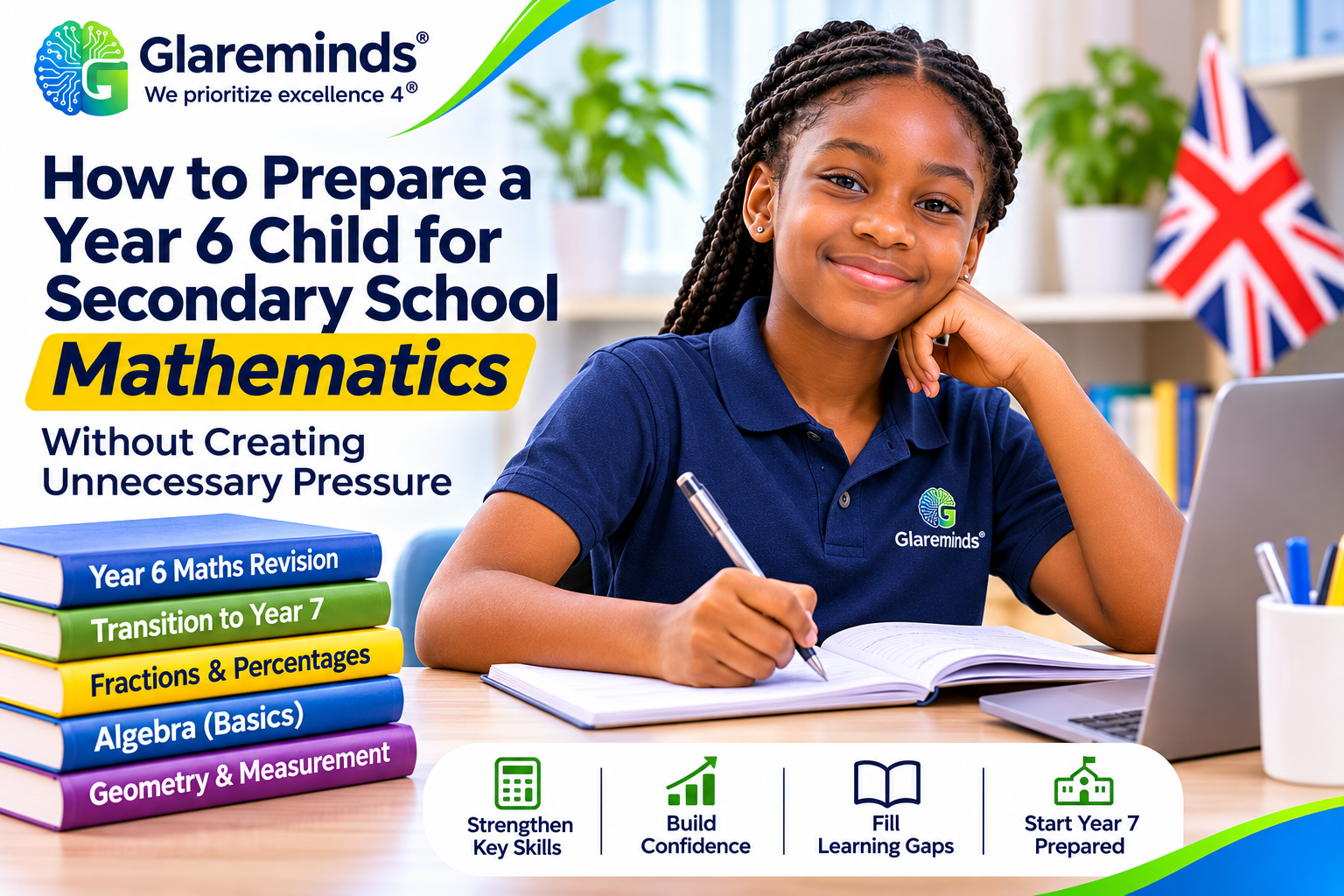
A practical guide for parents who want their children to enter secondary school with stronger mathematical foundations, confidence and independent problem-solving skills.
Moving from Year 6 to Year 7 is an important stage in a child's education.
For many children in the UK, the transition from primary to secondary school brings new expectations, different teachers, more demanding lessons and greater responsibility for independent learning.
Mathematics is one subject where this transition can become particularly noticeable.
A child who performs reasonably well in Year 6 may suddenly find secondary school mathematics more challenging. Topics become more complex, questions require several steps, and learners are expected to apply their knowledge rather than simply remember procedures.
Naturally, parents want their children to be prepared.
Some begin purchasing Year 7 mathematics workbooks, arranging additional lessons or encouraging their children to study more during the holidays. While preparation is valuable, too much pressure can make children anxious and less confident about mathematics.
The objective should not be to teach an entire Year 7 mathematics curriculum before secondary school begins.
Instead, parents should help children strengthen essential mathematical foundations, develop independent thinking and become comfortable tackling unfamiliar problems.
Here is how to approach the transition effectively.
1. Understand why Year 7 mathematics can feel different
Primary school mathematics often introduces concepts progressively, with considerable teacher guidance and opportunities to practise familiar question types.
Secondary school mathematics builds on these foundations but gradually expects students to work with greater independence.
In Year 7, learners may encounter:
- More complex calculations involving integers and negative numbers.
- Fractions, decimals and percentages in different contexts.
- Algebraic expressions and simple equations.
- Ratio and proportion.
- Angles and geometrical relationships.
- Perimeter, area and volume.
- Coordinates and graphs.
- Statistical representations and data interpretation.
- Multi-step mathematical problems.
The challenge is not necessarily that these topics are completely unfamiliar. It is that students are expected to connect ideas and apply previously learned knowledge in more demanding situations.
A child who struggles with multiplication, fractions or place value may find several Year 7 topics difficult because those earlier skills are used repeatedly.
This is why preparation should begin with the foundations.
2. Strengthen number skills before introducing advanced topics
Number skills are central to almost every area of secondary school mathematics.
Before introducing more advanced algebra or complicated calculations, make sure your child is comfortable with essential number concepts.
Important areas include:
Place value
Your child should understand the value of digits in whole numbers and decimals, including how numbers can be represented, compared and ordered.
Addition and subtraction
They should be able to work accurately with larger numbers, decimal values and negative numbers.
Multiplication and division
A secure understanding of multiplication facts and written methods helps students approach more complex calculations confidently.
Order of operations
Introduce the correct order of operations and allow your child to practise questions involving brackets and different operations.
For example:
[
6+3\times4=18
]
The multiplication is completed before the addition.
Factors, multiples and prime numbers
These concepts support later work involving fractions, number properties and algebra.
Parents should pay attention to accuracy and understanding rather than simply how quickly a child completes calculations.
3. Make sure your child understands fractions, decimals and percentages
Fractions, decimals and percentages are among the most important mathematical areas to strengthen before secondary school.
Students use these concepts in many Year 7 and later topics.
Your child should be able to:
- Identify and represent fractions.
- Find equivalent fractions.
- Simplify fractions.
- Compare and order fractions.
- Convert between simple fractions and decimals.
- Understand percentages as parts of 100.
- Calculate simple percentages of quantities.
- Apply these skills to everyday problems.
For example, ask your child:
A shop sells a school bag for £40 and offers a 25% discount. How much will the customer save, and what is the final price?
The learner should recognise that 25% of £40 is £10, making the discounted price £30.
This type of question tests more than calculation. It requires the child to interpret the situation and connect percentages with real-life applications.
Do not rush into difficult percentage questions if the child still struggles to understand what a fraction represents.
4. Introduce algebra gradually
Algebra can appear intimidating to children who have mainly worked with ordinary numbers.
However, the basic idea is straightforward: letters can represent unknown or changing values.
Before moving into complicated equations, help your child become comfortable with simple patterns and missing-number problems.
For example:
[
\Box+5=12
]
Ask your child to determine the missing number.
Then introduce a letter:
[
x+5=12
]
The next step could be:
[
3x=18
]
[
x=6
]
Gradually introduce:
- Understanding variables.
- Writing simple algebraic expressions.
- Substitution into expressions.
- Collecting like terms.
- Expanding simple brackets.
- Solving straightforward linear equations.
The goal is to make algebra feel like a natural extension of arithmetic rather than an entirely unfamiliar subject.
5. Develop problem-solving skills, not just calculation skills
One important difference between basic practice and more demanding mathematics is the ability to solve unfamiliar problems.
A learner may know how to calculate the area of a rectangle but struggle when the information is presented in a word problem.
For example:
A rectangular garden is 8 metres long and has an area of 40 square metres. What is its width?
The child needs to recognise that:
[
\text{Area}=\text{Length}\times\text{Width}
]
Therefore:
[
40=8\times\text{Width}
]
[
\text{Width}=5\text{ metres}
]
Encourage your child to:
- Read the question carefully.
- Identify the information provided.
- Determine what needs to be calculated.
- Choose an appropriate mathematical method.
- Show the working.
- Check whether the answer makes sense.
These habits will be useful throughout secondary school.
6. Build confidence with geometry and measurement
Geometry is another important area for Year 7 preparation.
Children should have a reasonable understanding of common two-dimensional and three-dimensional shapes, their properties and basic measurements.
Useful areas to review include:
- Types of angles.
- Properties of triangles.
- Properties of quadrilaterals.
- Parallel and perpendicular lines.
- Lines of symmetry.
- Perimeter and area.
- Basic volume.
- Coordinates.
- Reflection and other simple transformations.
For example, your child should know that angles on a straight line add up to 180 degrees and angles around a point add up to 360 degrees.
Encourage them to draw diagrams and label important information when solving geometry questions.
Visual learning can make abstract mathematical relationships easier to understand.
7. Teach your child how to learn independently
Secondary school requires students to take greater responsibility for their learning.
They will encounter different teachers, homework expectations and classroom routines.
A child who depends entirely on an adult to explain every question may find this transition difficult.
Parents can encourage independence by asking questions instead of immediately providing answers.
For example:
- What information does the question give you?
- Which mathematical concept does this remind you of?
- Can you think of another way to solve it?
- How could you check your answer?
- Where do you think your working went wrong?
Allow your child enough time to think.
If they make a mistake, guide them towards identifying it rather than simply correcting the answer.
This develops confidence and problem-solving habits that are valuable beyond mathematics.
8. Avoid turning the school holiday into another examination period
One mistake parents sometimes make is treating the period before secondary school as an opportunity to complete an entire additional curriculum.
Children need time to rest, play, explore interests and enjoy their holidays.
Academic preparation should be balanced and manageable.
A consistent routine involving short learning sessions can be more effective than long periods of compulsory revision.
For example, a family might introduce:
- Two or three short mathematics sessions each week.
- Occasional problem-solving activities.
- Everyday calculations involving money, measurements and time.
- Reading and educational activities.
- Time for hobbies, exercise and relaxation.
The exact routine should depend on the child's needs and existing confidence.
A child with secure mathematical foundations may only need occasional revision. A learner with significant gaps may benefit from more structured support.
There is no reason to create unnecessary anxiety by comparing children or rushing them through topics.
9. Identify learning gaps before secondary school begins
One of the most valuable things parents can do is understand where their child currently stands mathematically.
Do not assume that a child who has completed Year 6 has mastered every concept taught during primary school.
Some learners may have gaps in:
- Multiplication and division.
- Fractions and equivalent fractions.
- Decimal calculations.
- Percentages.
- Place value.
- Mathematical reasoning.
- Interpreting word problems.
These weaknesses can become more noticeable when students encounter demanding Year 7 topics.
A useful approach is to give your child a short assessment covering different areas of mathematics.
Look beyond the final score.
Observe which questions they answer confidently, which require assistance and which they cannot explain.
This will help you decide what should be revised before secondary school begins.
10. How parents can support the transition without creating pressure
A supportive home environment can make a significant difference to a child's attitude towards mathematics.
Consider these practical strategies:
Celebrate progress rather than perfection.
Recognise when your child understands something they previously found difficult.
Avoid negative comparisons.
Every child develops mathematical confidence at a different pace.
Make mathematics practical.
Use shopping, cooking, measuring and everyday activities to demonstrate how mathematics works.
Encourage questions.
Children should feel comfortable saying they do not understand something.
Focus on understanding.
Do not rush through a topic simply because your child can reproduce a few correct answers.
Create a manageable routine.
Short, consistent practice sessions are easier to sustain than excessive revision.
Allow room for mistakes.
Mistakes are useful when children are encouraged to understand and correct them.
11. When should parents consider additional mathematics tutoring?
Some children make the transition from Year 6 to Year 7 without significant difficulty.
Others need additional support, particularly when they have gaps in foundational mathematics or struggle with independent problem-solving.
One-to-one tutoring may be beneficial when:
- Your child consistently struggles with fractions, decimals or percentages.
- They find mathematical word problems difficult.
- They lack confidence when approaching unfamiliar questions.
- They understand lessons but cannot complete homework independently.
- They have difficulty explaining their mathematical reasoning.
- They need additional preparation for secondary school mathematics.
- They require a more individualised learning pace.
The purpose of tutoring should not be to overload the child with additional work.
It should provide structured explanations, appropriate practice and opportunities to develop confidence.
12. How Glareminds prepares learners for secondary school mathematics
At Glareminds, we believe that a successful transition to secondary school begins with strong academic foundations.
Our personalised one-to-one online tutoring helps learners identify mathematical weaknesses, strengthen essential concepts and develop independent problem-solving skills.
For children preparing to move from Year 6 to Year 7, our support can include:
Foundational mathematics review
We assess essential number skills, fractions, decimals, percentages and other important primary mathematics concepts.
Early secondary mathematics preparation
We introduce suitable Year 7 concepts progressively, based on the learner's existing understanding.
Problem-solving development
We help children interpret questions, choose appropriate methods and explain their reasoning.
Individualised teaching
Lessons are adapted to the child's learning pace, strengths and areas requiring attention.
Progress communication
Parents receive feedback on the learner's development and areas that may need further attention.
Our tutors are familiar with the British curriculum and other international education systems.
We aim to make mathematics more understandable, practical and engaging, helping children approach the next stage of education with greater confidence.
Frequently Asked Questions
1. What mathematics should a Year 6 child know before starting Year 7?
A child should ideally have a secure understanding of place value, the four operations, fractions, decimals, percentages, basic algebraic ideas, geometry, measurement and mathematical problem-solving. The precise preparation needed depends on the learner's existing understanding and the school's programme.
2. Should my Year 6 child start learning the Year 7 mathematics curriculum early?
Not necessarily. Strengthening Year 6 foundations is usually more valuable than rushing through advanced topics. Introducing selected Year 7 concepts can be useful once the child is comfortable with the relevant prerequisites.
3. How often should a Year 6 child practise mathematics during the holidays?
There is no single routine suitable for every child. A few short, consistent sessions each week may be sufficient for a learner with secure foundations. Children with specific learning gaps may need more structured support.
4. Why does my child struggle with Year 7 mathematics after doing well in Year 6?
The transition may expose weaknesses in earlier concepts, particularly fractions, number operations and mathematical reasoning. Secondary school also expects greater independence and application of knowledge.
5. Is algebra difficult for children moving into Year 7?
Algebra can initially seem unfamiliar because it introduces letters to represent unknown values. Starting with missing-number problems, patterns and simple expressions can make the transition easier.
6. Can an online tutor prepare my child for secondary school mathematics?
Yes. Personalised online tutoring can help children revise foundational topics, identify weaknesses and develop problem-solving skills. The effectiveness of the support depends on the quality of teaching, consistency and suitability of the learning plan.
7. How can I tell whether my child needs extra mathematics support?
Look for recurring difficulties with homework, poor understanding of foundational concepts, inability to solve unfamiliar questions independently or declining confidence. A targeted assessment can help establish whether additional support is appropriate.
Give Your Child a Confident Start to Secondary School
The move from Year 6 to Year 7 should be an exciting step, not a source of unnecessary academic pressure.
Your child does not need to know every Year 7 mathematics topic before secondary school begins.
What matters most is developing strong foundations, understanding mathematical ideas and having the confidence to approach new challenges.
At Glareminds, we help children strengthen these skills through personalised one-to-one tutoring designed around their individual learning needs.
Book a free 30-minute private consultation with Glareminds.
Let us understand your child's current mathematical ability and discuss how we can support a confident transition into secondary school.
Website: https://glareminds.com
WhatsApp: +234 703 947 2179
Glareminds – Personalised Learning. Exceptional Results.