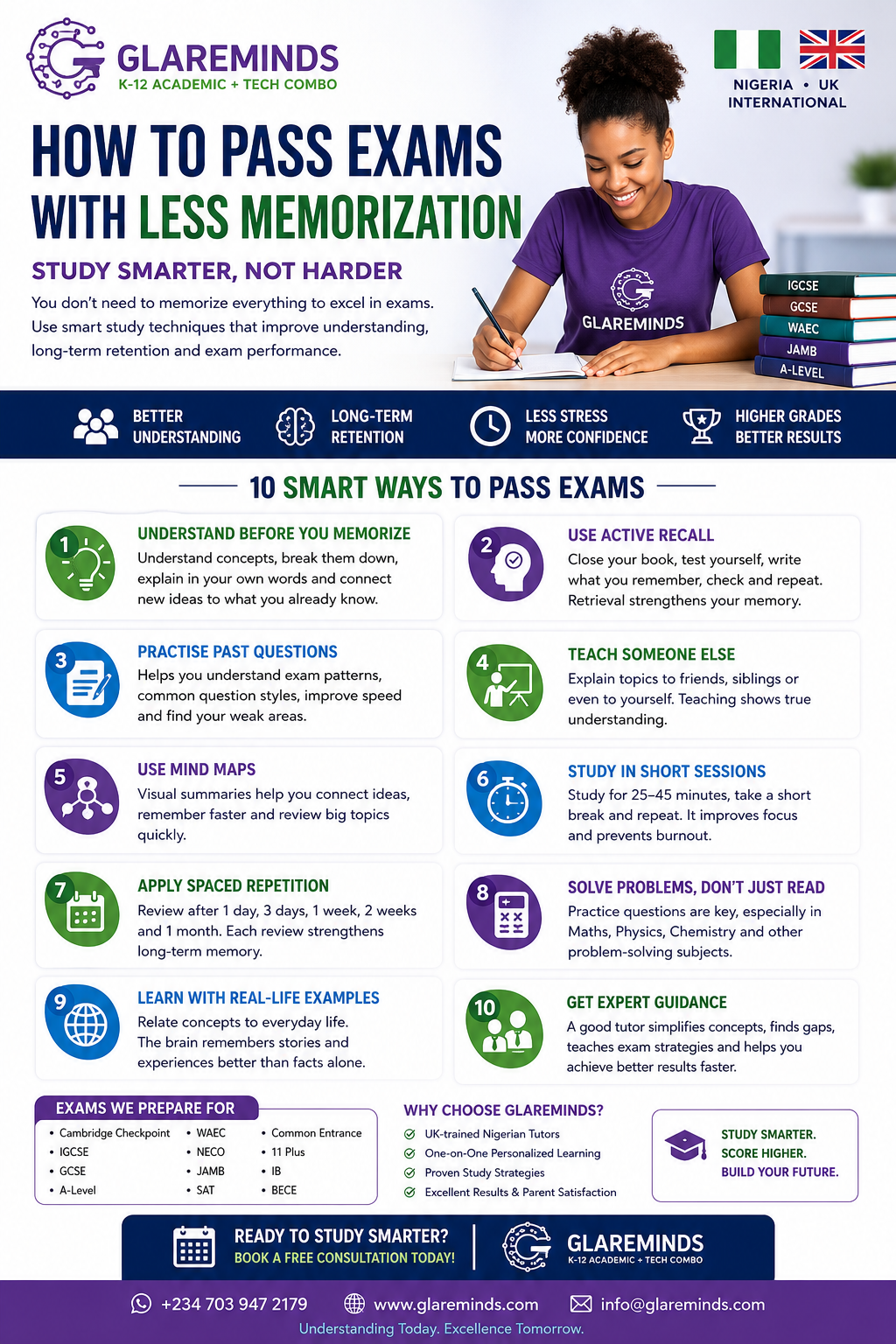
Many students believe that passing exams means memorizing hundreds of pages of notes. In reality, top-performing students rarely rely on memorization alone. Instead, they focus on understanding concepts, practising regularly, and using proven learning techniques that help information stick naturally.
Whether you're preparing for WAEC, NECO, JAMB, IGCSE, GCSE, Cambridge Checkpoint, SAT, A-Level, or Common Entrance, learning smarter can dramatically improve your grades while reducing stress.
Here's how you can pass exams with less memorization.
1. Understand Before You Memorize
Trying to memorize something you don't understand is one of the biggest mistakes students make.
Instead:
- Ask yourself why something works.
- Break difficult ideas into smaller parts.
- Explain concepts in your own words.
- Connect new knowledge to things you already know.
Understanding creates long-term memory far better than repeating facts.
2. Use Active Recall
One of the most powerful study methods is Active Recall.
Instead of reading your notes repeatedly:
- Close your book.
- Ask yourself questions.
- Write everything you remember.
- Check what you missed.
- Repeat.
Your brain becomes stronger every time you retrieve information from memory.
3. Practise Past Questions
Examiners often test similar concepts every year.
Past questions help you:
- Understand exam patterns.
- Identify common question styles.
- Improve speed.
- Discover weak areas.
Spend more time solving questions than rereading textbooks.
4. Teach Someone Else
If you can teach it, you truly understand it.
Try explaining topics to:
- Friends
- Parents
- Siblings
- Classmates
Even teaching yourself aloud helps strengthen understanding.
5. Use Mind Maps
Instead of memorizing long paragraphs, create visual summaries.
Mind maps help you:
- Connect ideas.
- See relationships.
- Remember information faster.
- Review large topics quickly.
A single mind map can replace several pages of notes.
6. Study in Short Sessions
Your brain learns better with focused study sessions.
A simple routine:
- Study for 25–45 minutes.
- Take a 5–10 minute break.
- Repeat.
This improves concentration and prevents mental fatigue.
7. Apply Spaced Repetition
Don't study a topic only once.
Review it after:
- 1 day
- 3 days
- 1 week
- 2 weeks
- 1 month
Each review strengthens long-term memory and reduces the need for cramming before exams.
8. Solve Problems, Don't Just Read
Subjects like:
- Mathematics
- Physics
- Chemistry
- Economics
- Accounting
cannot be mastered by memorization alone.
Success comes from solving many practice questions until the methods become familiar.
9. Learn with Real-Life Examples
Relating concepts to everyday life makes them easier to remember.
For example:
Instead of memorizing Newton's Laws, observe how bicycles, footballs, or moving cars demonstrate those principles.
The brain remembers stories and experiences much better than isolated facts.
10. Get Expert Guidance
Sometimes students struggle because no one has explained the topic properly.
A good tutor can:
- Simplify difficult concepts.
- Identify learning gaps.
- Build confidence.
- Teach effective exam strategies.
- Reduce unnecessary memorization.
Personalized learning often leads to faster improvement than studying alone.
Common Mistakes That Lead to Excessive Memorization
Avoid these habits:
- Reading the same notes repeatedly.
- Highlighting everything.
- Cramming the night before exams.
- Ignoring practice questions.
- Studying without understanding.
- Never reviewing old topics.
These methods consume time without improving long-term retention.
Why Understanding Beats Memorization
Students who understand concepts can:
- Answer unfamiliar questions.
- Solve complex problems.
- Think critically.
- Remember information for years.
- Perform better in school and future careers.
This is why many top students spend less time memorizing and more time practising and understanding.
How Glareminds Helps Students Study Smarter
At Glareminds, we believe success comes from understanding, practice, and confidence—not endless memorization.
Our experienced tutors provide personalized one-on-one lessons for students preparing for:
- Cambridge Checkpoint
- IGCSE
- GCSE
- A-Level
- WAEC
- NECO
- JAMB
- SAT
- 11 Plus
- Common Entrance
We teach proven learning strategies such as Active Recall, Spaced Repetition, exam techniques, and problem-solving skills that help students achieve excellent results.
Whether your child is studying in Nigeria, the UK, Canada, or anywhere in the world, Glareminds offers flexible online tutoring designed to help every learner succeed.
Final Thoughts
Passing exams doesn't require memorizing every page of your textbook. By focusing on understanding concepts, practising consistently, and using evidence-based learning techniques like Active Recall and Spaced Repetition, you can improve your grades while studying more efficiently.
Remember: Smart study habits always outperform endless memorization.
If you're looking for expert guidance and personalized support, Glareminds is here to help you study smarter, build confidence, and excel in every exam.
Frequently Asked Questions (FAQs)
Can I pass exams without memorizing everything?
Yes. Most high-achieving students rely on understanding, active recall, regular practice, and spaced repetition rather than memorizing every detail.
What is the best study method for difficult subjects?
For subjects like Mathematics and Science, focus on understanding concepts and solving plenty of practice questions instead of rote learning.
Does Active Recall really work?
Yes. Research consistently shows that actively retrieving information from memory improves long-term retention much more than passive rereading.
Which exams can these techniques help with?
These methods are effective for WAEC, NECO, JAMB, IGCSE, GCSE, Cambridge Checkpoint, A-Level, SAT, IB, and many other academic examinations.
Can Glareminds help improve my child's exam performance?
Absolutely. Glareminds provides personalized online tutoring, exam preparation strategies, and one-on-one coaching to help students achieve higher grades with confidence.
Call to Action
Ready to help your child study smarter instead of harder?
Book a free consultation with Glareminds today and discover how our expert tutors can help students excel in WAEC, IGCSE, GCSE, Cambridge Checkpoint, SAT, A-Level, and more.
Website: www.glareminds.com
WhatsApp: +234 703 947 2179
Email: info@glareminds.com
Image Alt Text Suggestions (SEO):
- Student studying smarter instead of memorizing
- How to pass exams with less memorization
- Glareminds online tutoring for exam success
- Active recall study technique infographic
- Smart study tips for WAEC and IGCSE students
This article is optimized around the primary keyword "pass exams with less memorization" while naturally incorporating related keywords to improve search visibility for Glareminds.
Instead of reading your notes repeatedly:
- Close your book.
- Ask yourself questions.
- Write everything you remember.
- Check what you missed.
- Repeat.
Your brain becomes stronger every time you retrieve information from memory.
3. Practise Past Questions
Examiners often test similar concepts every year.
Past questions help you:
- Understand exam patterns.
- Identify common question styles.
- Improve speed.
- Discover weak areas.
Spend more time solving questions than rereading textbooks.
4. Teach Someone Else
If you can teach it, you truly understand it.
Try explaining topics to:
- Friends
- Parents
- Siblings
- Classmates
Even teaching yourself aloud helps strengthen understanding.
5. Use Mind Maps
Instead of memorizing long paragraphs, create visual summaries.
Mind maps help you:
- Connect ideas.
- See relationships.
- Remember information faster.
- Review large topics quickly.
A single mind map can replace several pages of notes.
6. Study in Short Sessions
Your brain learns better with focused study sessions.
A simple routine:
- Study for 25–45 minutes.
- Take a 5–10 minute break.
- Repeat.
This improves concentration and prevents mental fatigue.
7. Apply Spaced Repetition
Don't study a topic only once.
Review it after:
- 1 day
- 3 days
- 1 week
- 2 weeks
- 1 month
Each review strengthens long-term memory and reduces the need for cramming before exams.
8. Solve Problems, Don't Just Read
Subjects like:
- Mathematics
- Physics
- Chemistry
- Economics
- Accounting
cannot be mastered by memorization alone.
Success comes from solving many practice questions until the methods become familiar.
9. Learn with Real-Life Examples
Relating concepts to everyday life makes them easier to remember.
For example:
Instead of memorizing Newton's Laws, observe how bicycles, footballs, or moving cars demonstrate those principles.
The brain remembers stories and experiences much better than isolated facts.
10. Get Expert Guidance
Sometimes students struggle because no one has explained the topic properly.
A good tutor can:
- Simplify difficult concepts.
- Identify learning gaps.
- Build confidence.
- Teach effective exam strategies.
- Reduce unnecessary memorization.
Personalized learning often leads to faster improvement than studying alone.
Common Mistakes That Lead to Excessive Memorization
Avoid these habits:
- Reading the same notes repeatedly.
- Highlighting everything.
- Cramming the night before exams.
- Ignoring practice questions.
- Studying without understanding.
- Never reviewing old topics.
These methods consume time without improving long-term retention.
Why Understanding Beats Memorization
Students who understand concepts can:
- Answer unfamiliar questions.
- Solve complex problems.
- Think critically.
- Remember information for years.
- Perform better in school and future careers.
This is why many top students spend less time memorizing and more time practising and understanding.
How Glareminds Helps Students Study Smarter
At Glareminds, we believe success comes from understanding, practice, and confidence—not endless memorization.
Our experienced tutors provide personalized one-on-one lessons for students preparing for:
- Cambridge Checkpoint
- IGCSE
- GCSE
- A-Level
- WAEC
- NECO
- JAMB
- SAT
- 11 Plus
- Common Entrance
We teach proven learning strategies such as Active Recall, Spaced Repetition, exam techniques, and problem-solving skills that help students achieve excellent results.
Whether your child is studying in Nigeria, the UK, Canada, or anywhere in the world, Glareminds offers flexible online tutoring designed to help every learner succeed.
Final Thoughts
Passing exams doesn't require memorizing every page of your textbook. By focusing on understanding concepts, practising consistently, and using evidence-based learning techniques like Active Recall and Spaced Repetition, you can improve your grades while studying more efficiently.
Remember: Smart study habits always outperform endless memorization.
If you're looking for expert guidance and personalized support, Glareminds is here to help you study smarter, build confidence, and excel in every exam.
Frequently Asked Questions (FAQs)
Can I pass exams without memorizing everything?
Yes. Most high-achieving students rely on understanding, active recall, regular practice, and spaced repetition rather than memorizing every detail.
What is the best study method for difficult subjects?
For subjects like Mathematics and Science, focus on understanding concepts and solving plenty of practice questions instead of rote learning.
Does Active Recall really work?
Yes. Research consistently shows that actively retrieving information from memory improves long-term retention much more than passive rereading.
Which exams can these techniques help with?
These methods are effective for WAEC, NECO, JAMB, IGCSE, GCSE, Cambridge Checkpoint, A-Level, SAT, IB, and many other academic examinations.
Can Glareminds help improve my child's exam performance?
Absolutely. Glareminds provides personalized online tutoring, exam preparation strategies, and one-on-one coaching to help students achieve higher grades with confidence.