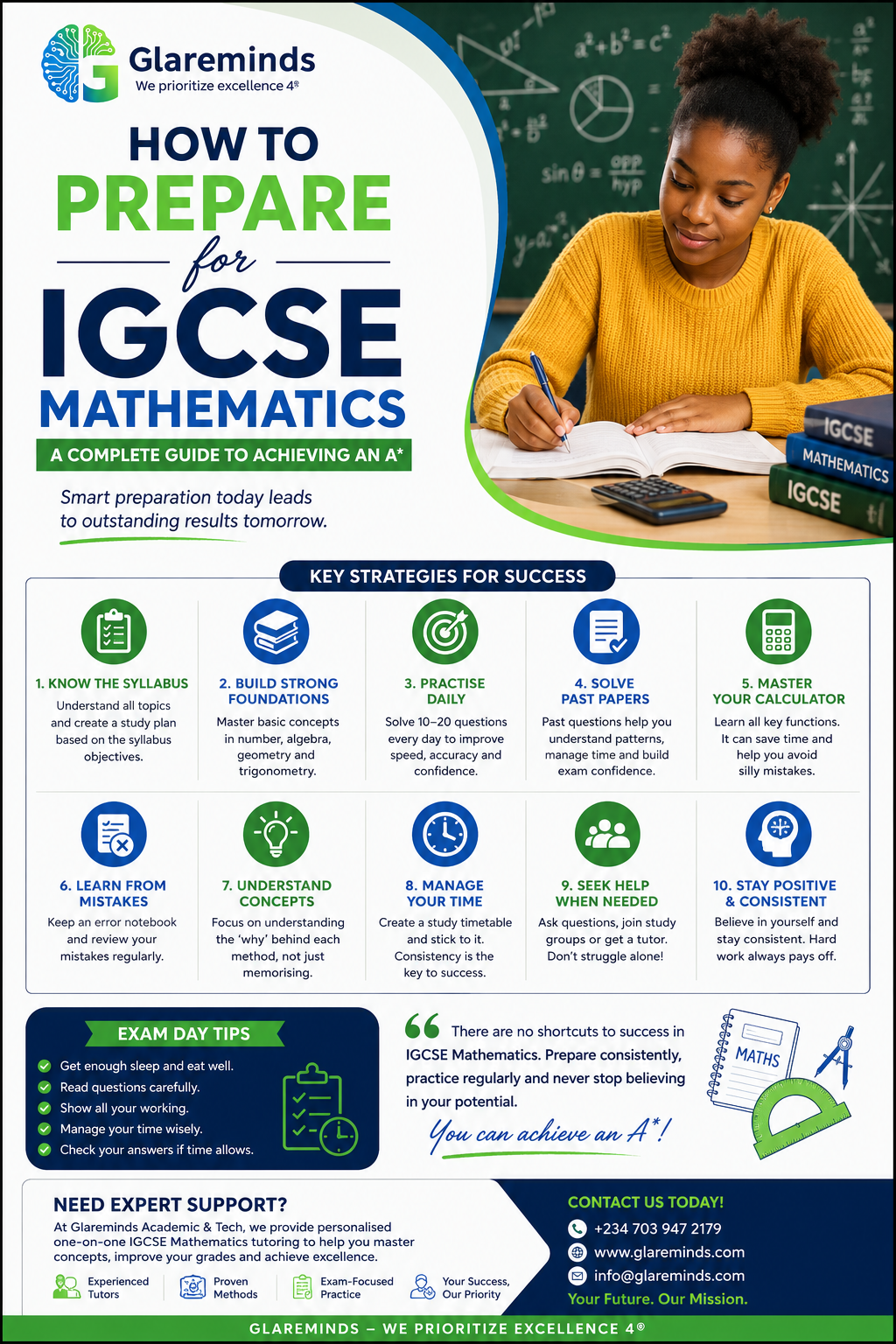
IGCSE Mathematics is more than just passing an examination—it is about developing logical thinking, problem-solving skills, and confidence that will benefit you throughout your academic journey. Many students believe that Maths is difficult, but with the right strategy, consistent practice, and proper guidance, anyone can achieve outstanding results.
Whether you're aiming for a Grade 9, an A*, or simply looking to improve your performance, this guide will help you prepare effectively.
1. Understand the IGCSE Mathematics Syllabus
Before you begin studying, download and read the official syllabus for your examination board (Cambridge or Edexcel). Knowing exactly what topics will be tested allows you to focus your efforts and avoid wasting time on irrelevant material.
Major topics include:
- Number and Algebra
- Geometry and Mensuration
- Trigonometry
- Probability
- Statistics
- Coordinate Geometry
- Functions and Graphs
- Vectors
- Transformations
Having a checklist of these topics helps you monitor your progress.
2. Build Strong Mathematical Foundations
Many students struggle with advanced topics because they have weak basics. Ensure you fully understand:
- Fractions, decimals, and percentages
- Ratios and proportions
- Indices and standard form
- Algebraic manipulation
- Equations and inequalities
Mastering these fundamentals makes more complex topics much easier.
3. Practise Every Day
Mathematics is a practical subject. Reading solutions alone will not improve your skills.
Aim to solve at least 10–20 questions daily. Focus on understanding the method rather than memorising answers. Consistent practice develops speed, accuracy, and confidence.
4. Learn the Concepts—Don't Memorise Procedures
Successful IGCSE students understand why a method works instead of simply memorising formulas.
For example:
- Why does Pythagoras' Theorem work?
- Why do we factorise equations?
- Why do trigonometric ratios solve right-angled triangles?
When you understand the reasoning, you'll be able to tackle unfamiliar questions with confidence.
5. Practise with Past Papers
Past papers are one of the most effective preparation tools.
They help you:
- Understand exam question styles
- Identify frequently tested topics
- Improve time management
- Build examination confidence
After completing each paper, carefully review your mistakes and learn from them.
6. Master Your Calculator
Many students lose marks because they don't know how to use their scientific calculator efficiently.
Learn how to:
- Use trigonometric functions
- Work with fractions
- Solve powers and roots
- Calculate statistics
- Use memory functions
A good calculator, combined with proper knowledge of its features, can save valuable exam time.
7. Learn from Your Mistakes
Mistakes are valuable learning opportunities.
Keep an "Error Notebook" where you record:
- Questions answered incorrectly
- The reason for each mistake
- The correct method
- Important formulas or concepts to remember
Review this notebook regularly to avoid repeating the same errors.
8. Improve Your Problem-Solving Skills
IGCSE Mathematics increasingly tests reasoning and application rather than routine calculations.
When solving problems:
- Read the question carefully.
- Highlight key information.
- Decide which mathematical concepts apply.
- Solve step by step.
- Check that your final answer makes sense.
9. Manage Your Time Effectively
Create a realistic study timetable.
For example:
- Monday: Algebra
- Tuesday: Geometry
- Wednesday: Trigonometry
- Thursday: Statistics
- Friday: Probability
- Saturday: Past Paper Practice
- Sunday: Review Weak Areas
Studying consistently is far more effective than cramming before the examination.
10. Seek Help When Necessary
If you are struggling with a topic, don't wait until it's too late.
Ask your teacher, join a study group, or work with an experienced tutor who can explain concepts clearly and provide targeted support.
Getting help early can make a significant difference in your final grade.
11. Stay Positive and Believe in Yourself
Your mindset plays an important role in your success.
Avoid saying:
"I'm just not good at Maths."
Instead, tell yourself:
"I can improve through practice, patience, and persistence."
Confidence grows with preparation.
Final Tips for Exam Day
- Get enough sleep the night before.
- Arrive early at the examination venue.
- Read every question carefully.
- Show all your working, even if you're unsure of the final answer.
- Manage your time wisely.
- Leave a few minutes to review your answers before submitting your paper.
Success in IGCSE Mathematics Starts Today
There are no shortcuts to success in IGCSE Mathematics. The students who achieve top grades are those who prepare consistently, practise regularly, understand concepts deeply, and learn from their mistakes.
Remember, every expert mathematician was once a beginner. Start where you are, stay consistent, and keep improving. With determination, smart preparation, and the right guidance, achieving an A* or Grade 9 in IGCSE Mathematics is within your reach.
Need expert support?
At Glareminds Academic & Tech, we provide personalised one-on-one IGCSE Mathematics tutoring designed to help students build confidence, master key concepts, and excel in their examinations. Our experienced tutors use proven teaching methods, structured practice, and regular assessments to ensure every learner reaches their full potential.
Start your journey to IGCSE success with Glareminds today!